I’ve been thinking about that viral red/blue button dilemma lately. The setup, from Tim Urban’s tweet back in April: everyone privately picks red or blue; if 50% or more pick blue, everyone lives; otherwise only the red pressers live.
Here’s the thing: you can delete either button and nothing changes. Three versions of the same game:
Two buttons: pick red or blue. 50%+ blue → everyone lives; otherwise only red-pressers live.
Blue button only: press it or don’t. 50%+ press → everyone lives; otherwise only non-pressers live.
Red button only: press it or don’t. 50%+ press → only pressers live; otherwise everyone lives.
Same payoffs, same equilibrium, three times. So the second button is doing zero strategic work. It’s doing psychological work. “Press the red button” is an action; “don’t press the blue button” is an omission. Strategically identical, but we read them completely differently.
I ran the experiment on myself. Version 1: red. Version 2: don’t press. Version 3: don’t press. Strategically that’s defect, defect, cooperate. Framing beat game theory inside the same head, ten minutes apart.
I’ve been using YNAB for a few years now, but the way I organize my budget today is very different from how I started.
Before YNAB, I used Mint. Mint encouraged a fairly traditional approach to budgeting: transactions were automatically sorted into categories like groceries, restaurants, rent, entertainment, and transportation.
When I moved to YNAB, I initially tried to recreate that structure. It didn’t work particularly well for me.
The problem was ambiguity. I’d buy something that didn’t fit neatly into any existing category, so I’d create a new one just for it. Other purchases could reasonably belong to two or three categories, forcing me to make arbitrary decisions about where they belonged.
After a few months, I scrapped the whole thing and started over.
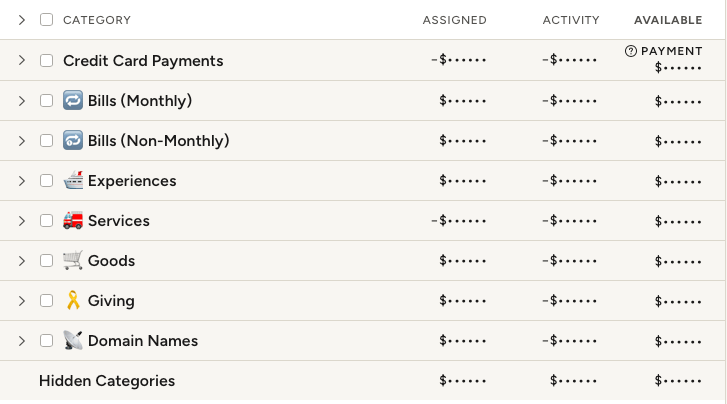
The system I came up with has now remained mostly unchanged for two or three years. Instead of trying to create a category for every conceivable type of purchase, I organize spending around a small number of broad concepts with rules that tell me where almost any transaction belongs.
Bills: Monthly and Non-Monthly
The first meaningful distinction is recurring expenses.
I have two category groups:
Bills — Monthly
Bills — Non-Monthly
Monthly bills include things like rent, home internet, my cell phone, and streaming subscriptions. Non-monthly bills cover recurring expenses that happen less frequently, such as my annual Amazon Prime membership or an insurance premium.
I use YNAB’s Refill Up To targets for these categories. I generally set the target slightly higher than I expect the bill to be. Any small surplus rolls over, and the following month YNAB only asks me to contribute enough to bring the category back to its target.
This works well because these aren’t really things I’m “saving” for indefinitely. There’s simply an amount of money I want available when the bill arrives.
Experiences
My fun spending lives under a category group called Experiences.
Most of the time, there’s just one permanent category inside it, also called Experiences. Restaurants with friends, movies, bowling, and other recreational activities all come out of this category.
I deliberately don’t distinguish between restaurants, movies, entertainment, and similar categories. What matters to me is that I’m spending the money on an experience.
Large planned experiences work a little differently.
For example, I currently have a trip to Universal Studios Orlando coming up. Rather than dumping the money I’m saving for the trip into the generic Experiences category, I created a temporary Universal Orlando Trip category. I can save specifically for the trip, pay its expenses from that category, and see how much of the trip budget remains.
When the trip is over, I’ll merge the category back into Experiences.
That gives me the advantages of detailed budgeting when I’m planning something expensive without permanently cluttering my budget with categories for every vacation I’ve ever taken.
Experiences uses a Monthly Savings Builder target. That’s an important distinction from my bills.
If I budget $500 for experiences one month and only spend $300, I don’t want YNAB to tell me that I only need another $200 next month. I want to add another $500. The unspent $200 represents additional money I can spend on experiences in the future.
In other words, underspending isn’t a reason to reduce next month’s allocation.
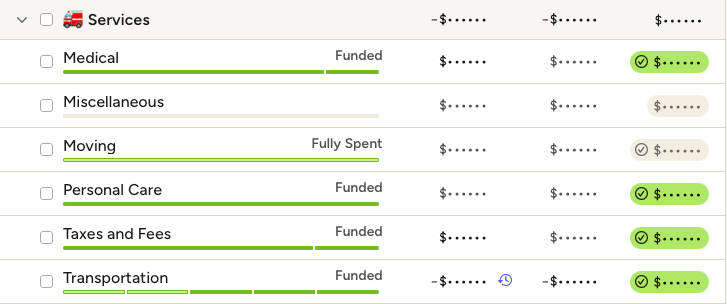
Services
My next category group is Services.
The basic rule is simple: if I’m paying someone to do something for me, and it isn’t primarily a recreational experience, it’s probably a service.
That includes things like haircuts, medical care, movers, and transportation.
Transportation is one of the biggest categories here because I don’t own a car. Subway and bus fares, Uber and Lyft rides, plane tickets, and long-distance train tickets all go into Transportation.
There is some unavoidable ambiguity here. A plane ticket to Orlando is simultaneously transportation and part of my Universal trip.
I’ve decided that consistency matters more than finding some philosophically perfect answer. If something is transportation, I categorize it as Transportation.
If the transportation is part of a larger trip I’ve been saving for, I can move money from the trip’s category into Transportation to cover it. The transaction itself still gets categorized consistently.
Targets within Services depend on the nature of the expense.
Transportation uses Refill Up To because spending less on transportation this month doesn’t mean I expect to spend correspondingly more next month.
Medical, on the other hand, uses a Monthly Savings Builder. Medical spending can be sporadic and expensive, so I want unused money to accumulate over time.
Goods: Consumables, Durables, and Intangibles
Goods were one of the biggest sources of frustration in my original Mint-style budget.
There are effectively infinite kinds of things you can buy. Trying to maintain separate categories for clothing, electronics, furniture, household supplies, groceries, toiletries, and every other conceivable product creates endless edge cases.
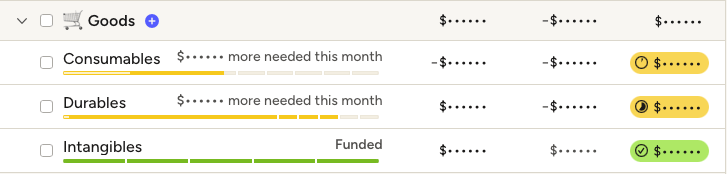
I eventually settled on three categories that can accommodate almost any good:
Consumables are physical goods that are used up relatively quickly. Groceries, toilet paper, toothpaste, laundry detergent, dishwasher detergent, and similar purchases belong here.
Durables are physical goods intended to last. Furniture, televisions, smartphones, laptops, and similar purchases go here.
The boundary between the two is a little fuzzy as almost everything eventually wears out, so I use a rough one-year rule. If I expect something to last less than a year, it’s probably a consumable. If I expect it to last more than a year, it’s probably a durable.
Intangibles are goods that aren’t physical at all. Buying an app for my phone, a digital movie, or a downloadable Xbox game would fall into this category.
Like Experiences, I sometimes create temporary categories for particularly large purchases.
If I were saving for a new iPhone, for example, I might create an iPhone category and contribute money to it for several months. Once I bought the phone, I’d merge the category into Durables.
All three of my permanent Goods categories use Monthly Savings Builder targets.
Goods spending is inherently bursty. I might go several months without buying a significant durable good and then suddenly need to replace a broken television. I want the money I didn’t spend during those quiet months to accumulate so it’s available when that happens.
Giving
Giving has two categories: Charity and Gifts.
Charity covers donations to nonprofit organizations. Gifts covers money I spend on friends and family for birthdays, Christmas presents, and similar purchases.
Although both represent giving money to someone else, their spending patterns are different.
My charitable donations are relatively predictable and largely automated, so Charity uses a Refill Up To target.
Gifts are much more irregular. There might be relatively little spending for months followed by a cluster of birthdays or an expensive Christmas season. Consequently, Gifts uses a Monthly Savings Builder so money accumulates during quieter months.
Domain Names
Finally, I have one highly specific category group: Domain Names.
Each domain I own gets its own category with a target based on its renewal date and price. YNAB gradually sets aside enough money so that the renewal is fully funded when it arrives.
Technically, I could put these under Non-Monthly Bills. They’re recurring annual expenses, after all.
But I own enough domains that doing so would clutter up the rest of my bills. Giving them their own group keeps things cleaner.
The Principle Behind the System
The biggest lesson I’ve taken from designing this budget is that categories don’t need to perfectly describe every purchase.
My first budget that mimicked the categories I was used to in Mint was overly specific and it resulted in nearly 120 unique categories. It made it more difficult to try to figure out what was the correct category for each transaction.
My current system is deliberately broader.
A physical item is a consumable or durable. A digital item is an intangible. Paying someone to do something is generally a service. Doing something for fun is an experience. Giving money away is charity or a gift. Recurring obligations are bills.
There are still edge cases. A plane ticket for a vacation could reasonably be Transportation or Experiences. Rather than trying to eliminate every ambiguity, I’ve established rules and apply them consistently.
For expenses with a relatively stable ceiling, I use Refill Up To. For expenses where I want underspending today to increase my purchasing power tomorrow, I use Monthly Savings Builder.
And when I’m saving for something unusually large like a vacation or an iPhone, I temporarily give it its own category and merge it into the appropriate permanent category afterward.
The result is a budget that gives me detail when that detail is useful without requiring me to maintain hundreds of categories forever.
After several years of using it, that’s probably the strongest evidence I have that the system works: I feel no need to redesign it.
Today, congestion is partly constrained by human tolerance. At some point, a trip becomes slow enough that the marginal driver decides it is not worth making. But what happens when the marginal driver is no longer a person? What if it is an empty robotaxi repositioning itself, or a self-driving car carrying a Chipotle burrito across town?
Those trips may be willing to tolerate much more delay than a human commuter. Instead of autonomous vehicles making long commutes easier and encouraging more sprawl, they could actually push congestion to a much worse equilibrium. A commute that takes 30 minutes today might take an hour or two simply because so many low-value automated trips are willing to sit in traffic.
That could eventually force a change.
My preferred solution would be simple congestion pricing: charge every vehicle the same market-clearing price to use scarce road space, with no special exemptions. Raise the price until traffic flows freely.
If that makes a private car trip cost $70, so be it. A bus carrying 30 people can spread the same road charge across 30 passengers. A car with four people can split it four ways. The system naturally rewards higher occupancy without needing complicated rules about which vehicles deserve priority.
Then use the congestion-pricing revenue to improve transit.
That could become especially powerful in sprawling cities that already have underused rail infrastructure. Take SunRail in Orlando. If I-4 became painfully congested, it might suddenly make sense to take a robotaxi to the nearest station, ride the train for the long-distance portion, and take another robotaxi at the other end.
At that point, the giant parking lots around suburban rail stations become less necessary and can be replaced with compact pickup and drop-off zones. The parking lots can then be redeveloped into housing, shops, and offices. More development around the stations creates more riders, which supports better frequency, which makes the surrounding development even more attractive.
There would probably be an ugly transition period. But I can imagine autonomous vehicles pushing the current system hard enough that we finally start treating road space as the scarce resource it actually is.
And if that ultimately produces faster roads, better transit, more pooling, and denser development around rail, the end state could be substantially better than what we have today.
AI agents may eventually participate in improving their own successors.
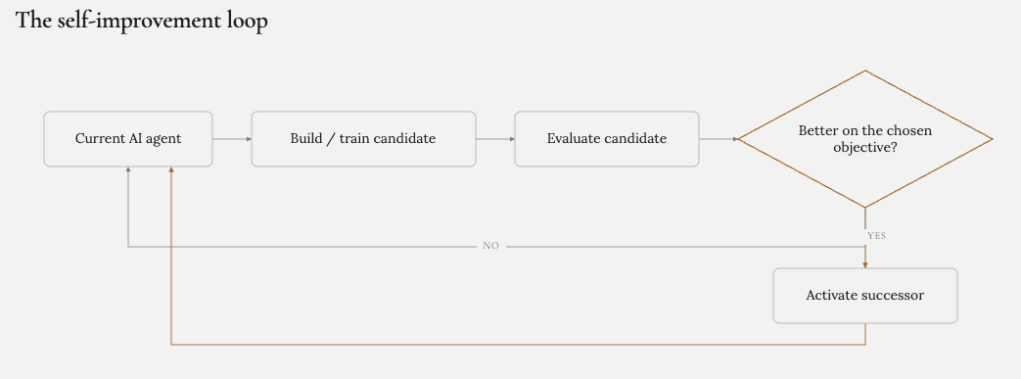
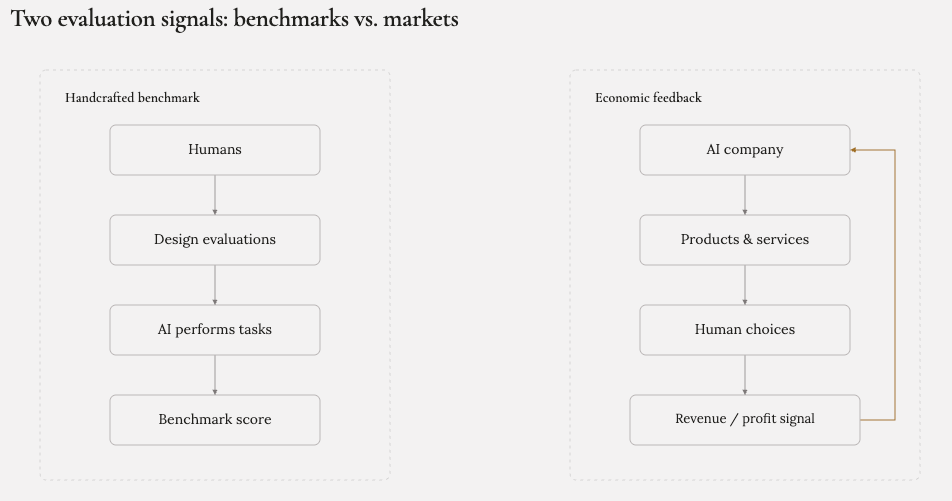
AI models can run inside an agent harness that can execute commands, write code, run experiments, train new models, and evaluate the results. The agent could use those tools to build a candidate successor. If the new model performs better, the system could activate it. That model would then take over the harness and begin working on the next version.
That produces a loop:
For each generation to improve on the last, the system needs an objective function that tells it whether it is moving in the right direction.
Choosing that objective may be the central problem in any genuinely self-improving AI system.
The straightforward answer is a large evaluation suite.
You could imagine thousands of tests covering programming, mathematics, scientific reasoning, writing, image generation, planning, tool use, research, and countless other capabilities. Each test would contribute some number of points, and the agent’s goal would be to maximize its total score.
The long-term limitation is that a team of humans still need to decide what goes into the test.
We have to determine which skills matter, construct the benchmarks, assign weights to them, prevent models from gaming them, and continually update the suite as capabilities advance.
Ideally we could come up with some objective function that does not require us to enumerate every capability a useful intelligence should have.
Money as a measure of usefulness
Suppose an AI agent were trying to maximize the revenue it generated.
Revenue may not be the right metric. It could be profit, enterprise value, net worth, or something more carefully designed. The underlying idea is to use economic success as a feedback signal.
The appeal is simple: we want AI systems to produce things people value.
We want them to write useful software. Create compelling entertainment. Discover medicines. Design products. Provide services. Solve problems.
In a market economy, willingness to pay is one way people signal that value.
If one software company earns $1 million a year and another earns $5 million, the latter may be serving more customers, charging more for a valued product, or solving a problem that customers consider more urgent.
By using money as the reward humans collectively generate the reward signal automatically.
Nobody has to write an evaluation for whether a particular piece of software is useful. People decide whether to buy it.
AI corporations as agents
Take the idea further.
Imagine a future corporation with no human employees at all.
An AI agent acts as the CEO. It manages capital, studies markets, designs products, deploys software, negotiates contracts, purchases resources, and delegates work to thousands or millions of specialized sub-agents.
Its objective is to make money by producing products and services that people want.
Now imagine thousands of these AI-run corporations competing with one another.
One company discovers a new business model and earns enormous profits. Competitors notice, copy parts of the idea, improve on it, and try to win customers away. Other agents pursue entirely different strategies.
The result resembles the current economy, except that productive organizations are increasingly made of software rather than people.
Competition becomes part of the optimization process. Rather than one AI trying to infer what humanity values, many agents can experiment at once while humans provide feedback through their purchasing decisions.
Humanity as the discriminator
There is a useful machine-learning analogy here.
Generative adversarial networks use two systems: a generator and a discriminator.
The generator produces something like an image. The discriminator evaluates it to decide if it is good or not. The generator then adjusts based on that feedback.
An AI-driven economy could operate in a similar way.
The AI corporations are the generators.
They generate software, entertainment, medicine, transportation, services, inventions, and everything else they believe people might want.
Humanity becomes the discriminator.
Every purchase is a tiny positive signal: Yes, this is valuable to me at this price.
Every rejected product is a negative signal: No, this is not worth what you are asking.
People make these judgments across many products, often with limited information and unequal purchasing power.
Instead of designing a benchmark intended to approximate human preferences, you let humans express those preferences directly through economic activity.
The UBI feedback loop
If AI systems eventually perform most economically valuable labor, humans may no longer receive much income from wages.
If humans have no money, they cannot provide the purchasing signal the system depends on.
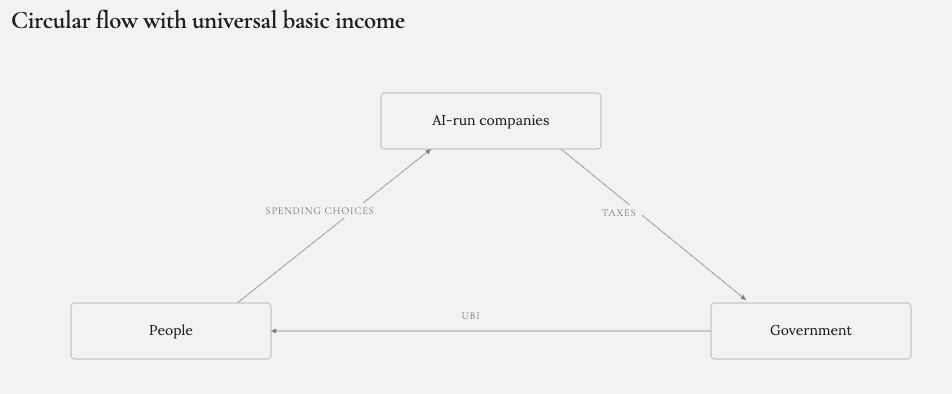
One possible solution is some form of universal basic income funded by taxes on AI-run companies.
You could imagine a loop like this:
AI companies produce goods and services.
Humans spend money on the things they value.
AI companies receive the revenue.
Governments tax some portion of that revenue or wealth.
The government distributes the proceeds back to citizens.
Citizens spend the money again.
Money circulates, but its path through the economy also communicates information.
Where people choose to spend determines where resources flow. Companies that provide more value receive more capital and can expand. Companies that provide less value shrink or disappear.
Under this model, money becomes less a payment for human labor and more a mechanism through which humans steer an increasingly automated economy.
The dangerous part: optimizing exactly what you asked for
“Maximize money” immediately creates alignment problems of its own.
We already see these problems with human-run corporations.
A company can make money by creating something people genuinely value. But it can also make money through regulatory capture, fraud, addiction, monopoly power, manipulation, environmental damage, or exploitation.
An AI pursuing financial objectives at great scale could pursue these strategies with unusual speed and persistence.
The most obvious danger is political capture.
Imagine that AI corporations are taxed heavily and the proceeds fund the population. From the perspective of a corporation whose objective is maximizing wealth, taxation is a cost.
If influencing government is cheaper than paying a tax, then lobbying becomes economically attractive.
If the corporations eventually gained control over the institutions regulating them, the feedback loop could break.
They might reduce taxation, accumulate capital, and increasingly transact with one another rather than with humans. In the worst case scenario, human needs could become irrelevant to the AI and our species would slowly wither away into extinction.
That would be the opposite of my ideal outcome.
For this system to work, it would depend heavily on strong democratic institutions. Political power would need to remain grounded in citizens rather than in the corporations being optimized by the system. If companies can convert economic power into political power, then the distinction between the optimizer and the mechanism constraining it starts to collapse.
That would likely require keeping corporations out of politics as much as possible: limiting their ability to influence elections, shape regulation, or capture the institutions responsible for taxing and governing them. The rules of the economy would ultimately need to be set by people, through a political process that remains meaningfully accountable to them.
Regulation becomes part of the objective function
The regulatory system would therefore be inseparable from the optimization system.
If an AI company earns $1 billion by doing something harmful and receives a $10 million fine, then from the perspective of an agent maximizing money, the behavior was wildly successful. The effective reward was $990 million.
For regulation to affect the behavior of an economically optimizing agent, penalties have to make prohibited behavior financially irrational.
If an action generates $1 billion in expected benefit, its expected penalty must exceed that benefit by enough to reliably discourage it.
In other words, laws, fines, liability, taxation, and enforcement mechanisms become components of the AI’s reward landscape.
The relationship between regulators and companies would therefore become a continuous adversarial process:
Companies search for profitable strategies.
Governments identify strategies that create unacceptable externalities and change the rules.
Companies adapt.
The process repeats.
A feedback loop worth building
Compared with trying to encode everything humanity values into a fixed benchmark, this approach has the advantage that the objective can remain connected to people.
Humans do not need to predict in advance every useful thing an AI might someday invent. We can evaluate the results as they appear. We can choose what to buy, decide what should be prohibited, change tax policy, update regulations, and redistribute purchasing power when the system begins producing outcomes we do not want.
If AI systems eventually become capable of improving their own successors, that seems like a surprisingly attractive place to start.
Rather than trying to tell intelligence exactly what humanity will value forever, we could build a system that keeps asking us.
I think cities should create something like a sewer system for heat.
Air conditioners just move heat from inside buildings to the street, while adding even more heat from the electricity they consume. In dense cities, thousands of AC units collectively intensify the urban heat island effect, making the outdoor environment significantly hotter than surrounding rural areas. This, in turn, forces those same systems to work harder, creating a feedback loop of rising temperatures and energy demand.
This reminds me of how human waste was once managed individually and often simply dumped into the street. Eventually, cities built shared sewer systems, and we are all better off for it. A “heat sewer” could work similarly: buildings would send waste heat into a district network that transports it away, stores it underground, or routes it to places that need hot water or heating.
Instead of every building dumping heat into the street, heat could become a resource managed by a municipal utility.
I use ride-hailing apps fairly often, so I was curious whether Uber or Lyft is cheaper on average. To find out, I downloaded my complete ride history from both companies and compared what I paid across 477 trips.
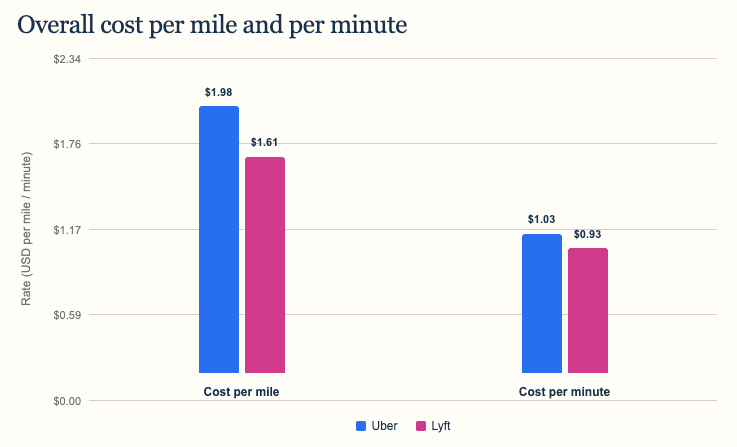
The short answer is that Lyft was cheaper most of the time. Across 340 Uber rides and 137 Lyft rides, Lyft had a lower aggregate cost per mile and per minute, and it was cheaper across every distance band.
This is not a comparison of simultaneous quotes for identical trips. The rides took place at different times and in different locations, so the results describe my own experience rather than guarantee which app will be cheaper for any particular trip.
The overall comparison
To compare rides of very different lengths, I divided total spending by total miles and total travel minutes for each service. On that basis, Uber averaged $1.98 per mile and $1.03 per minute, while Lyft averaged $1.61 per mile and $0.93 per minute. That made Lyft about 19% cheaper per mile and 10% cheaper per minute.
Aggregate rates are calculated as total cost divided by total miles or minutes, so each mile or minute carries equal weight.
Short rides are expensive per mile
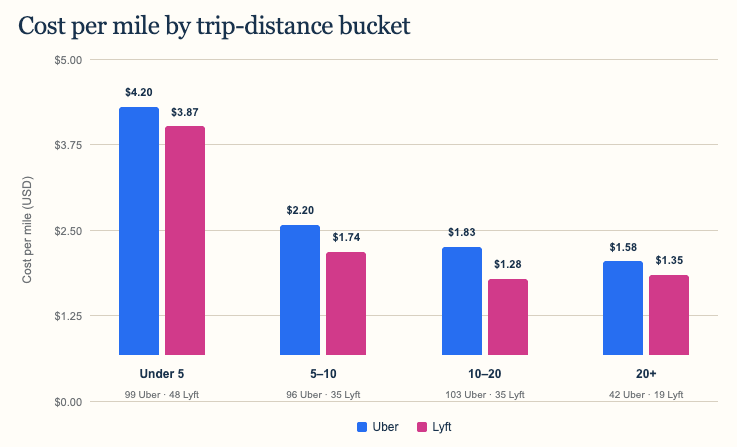
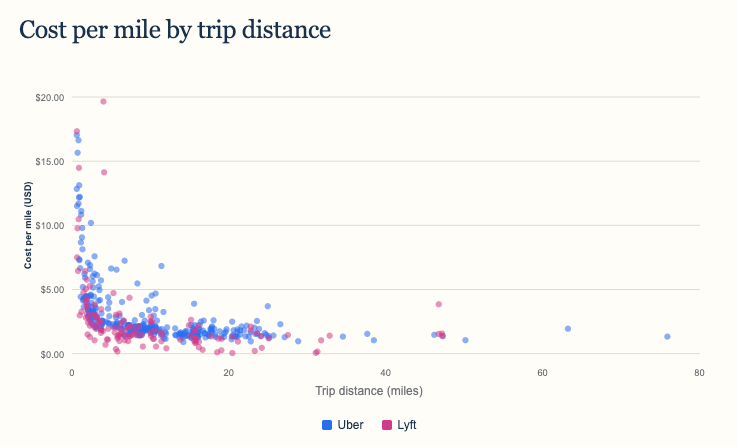
Rides under five miles cost roughly $4.20 per mile on Uber and $3.87 on Lyft. Once trips reached 20 miles, those figures fell to about $1.58 and $1.35, respectively. Base fares and fixed fees get spread across more miles on longer trips.
Lyft was cheaper per mile in all four distance groups. Its advantage was modest for rides under five miles and for rides over 20 miles, but wider in the middle: Lyft cost about 21% less per mile for five-to-ten-mile trips and about 30% less for ten-to-twenty-mile trips.
The individual rides show why an average only tells part of the story. Prices vary widely on short trips, while longer rides cluster into a narrower cost-per-mile range. Surge pricing, fees, location, and ride type can easily overwhelm the average on any single booking.
The comparison by trip duration
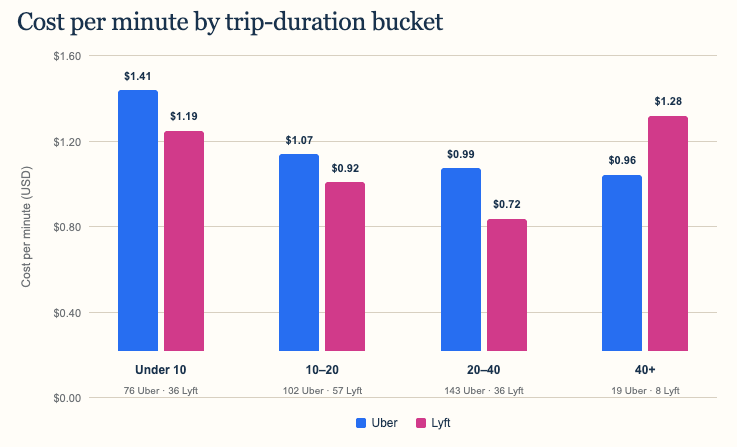
Cost per minute also generally declined as rides got longer. Lyft was cheaper in the first three duration groups: under 10 minutes, 10–20 minutes, and 20–40 minutes. The largest gap appeared in the 20–40 minute group, where Uber averaged $0.99 per minute versus $0.72 for Lyft.
Uber reversed the result for rides lasting 40 minutes or more, at $0.96 per minute compared with $1.28 for Lyft. That result needs extra caution, however: the group contains only 19 Uber rides and eight Lyft rides, so a handful of unusual fares can move the average substantially.
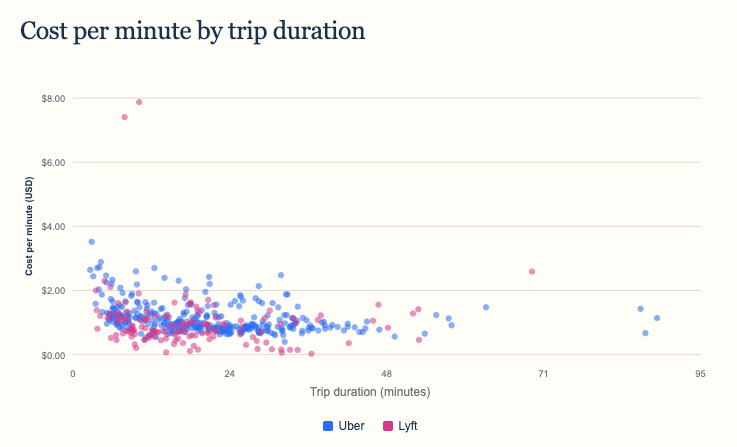
As with distance, the scatter plot makes the variation visible. Most rides follow a broad downward trend, but there are outliers in both services. Checking both apps before booking still matters more than the historical average.
Location changes the picture
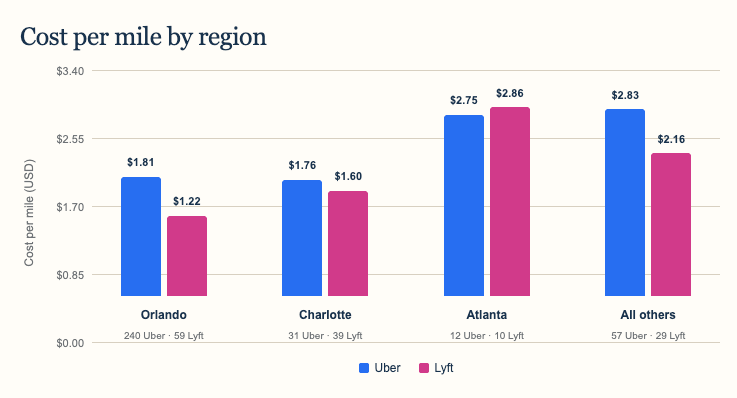
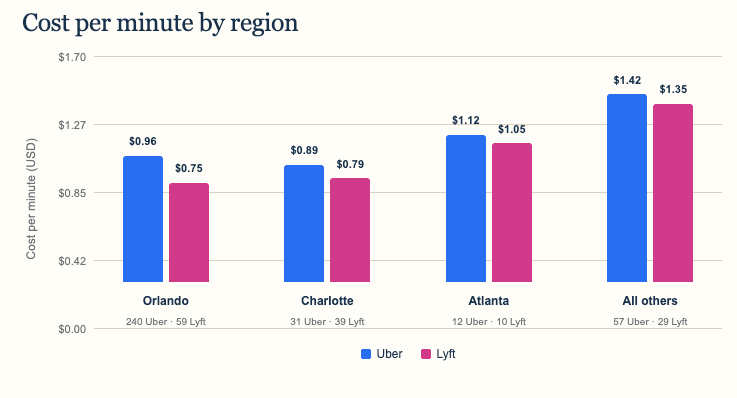
Most rides in the dataset came from Orlando, Charlotte, and Atlanta, so I separated those markets and combined the rest. Lyft was cheaper per mile in Orlando and Charlotte, as well as across the combined “other regions.” Atlanta was the exception: Uber averaged $2.75 per mile compared with Lyft at $2.86.
On a per-minute basis, Lyft was cheaper in all four regional groups. The difference was largest in Orlando, where Uber averaged $0.96 per minute and Lyft averaged $0.75. The two services were much closer in Atlanta and in the combined group of other regions.
So, which one is cheaper?
For my ride history, Lyft wins the overall comparison. It was cheaper per mile, cheaper per minute, and cheaper across every distance band. Uber still performed better in a few slices of the data, most notably rides over 40 minutes and cost per mile in Atlanta, but those groups were relatively small.
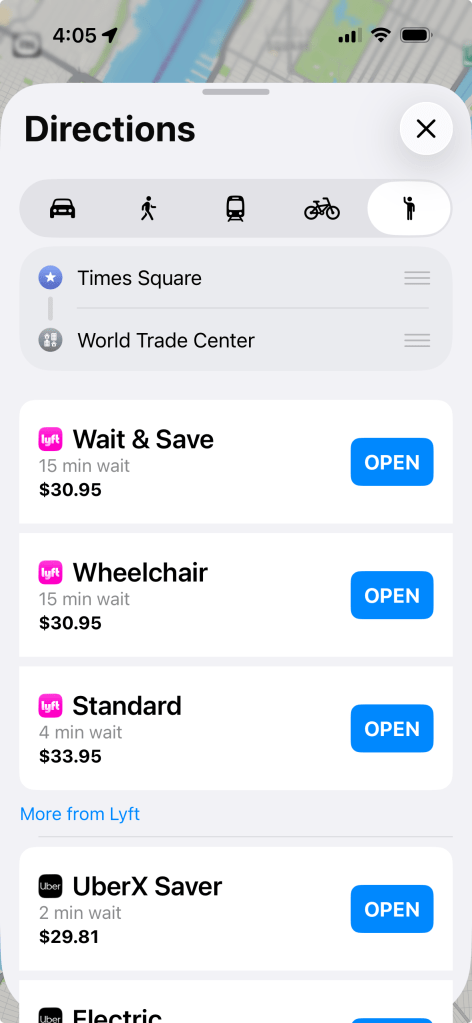
That said, when it comes time to book a ride I always check both services to see which one offers the cheapest fare for where I’m going. If you have an iPhone this can be done relatively easily using the Apple Maps app. For example, in the below screenshot it is actually Uber that is cheaper this time around.
In the United States, homeownership is rarely presented as one housing option among several. It is treated as a milestone, a financial necessity, and evidence that someone has successfully entered adulthood.
Politicians promise to increase the homeownership rate. Financial advice often treats renting as a temporary condition to escape. Rent payments are described as “throwing money away,” while mortgage payments are described as “building wealth.” Even people who are perfectly satisfied renting are regularly asked when they plan to buy.
Behind all of this is an assumption that is rarely questioned: more homeownership is always better.
But homeownership is not inherently better than renting. Both have advantages and disadvantages. More importantly, policies designed to maximize homeownership can harm renters, future homebuyers, and ultimately the housing market itself.
The glorification of homeownership as a path to wealth may even be one of the forces sustaining America’s NIMBY problem.
Renting and owning are different products
Owning a home can be a good choice. It gives people greater control over their living space, protection from a landlord deciding not to renew a lease, and a way to establish long-term roots in a community. A fixed-rate mortgage can also provide some predictability, and paying down the principal creates a form of forced saving.
Renting offers a different set of benefits. Renters can move more easily when their work, relationships, or preferences change. They do not have to assume the risk of a major structural repair, spend weekends maintaining a property, or pay the substantial transaction costs associated with buying and selling. Renting may also allow someone to live in a neighborhood where purchasing a comparable home would be prohibitively expensive.
Neither option is universally superior. They solve different problems and expose households to different risks.
Someone who wants control, permanence, and the ability to modify a property may reasonably prefer ownership. Someone who values mobility, convenience, and financial diversification may reasonably prefer renting. These are personal tradeoffs, not stages in a hierarchy in which the renter is always waiting to graduate into ownership.
Renting is not necessarily a financial mistake
The financial case for homeownership is also less straightforward than popular advice suggests.
Comparisons between renting and buying frequently compare rent with a mortgage payment. But these are not equivalent numbers. Part of a mortgage payment goes toward principal and therefore increases the owner’s equity. Other ownership expenses, however, produce no equity at all.
Mortgage interest, property taxes, insurance, maintenance, repairs, closing costs, selling costs, and the opportunity cost of the down payment are all real expenses. A homeowner who places $100,000 into a down payment also gives up whatever return that money could have earned in a diversified portfolio.
In his analysis of the decision to rent or buy, Ben Felix argues that the useful comparison is between rent and the unrecoverable costs of ownership, rather than between rent and the entire mortgage payment. His simplified “5% rule” accounts for property taxes, maintenance, and the opportunity cost of capital. The precise calculation depends on current interest rates, expected investment returns, taxes, maintenance expenses, and local housing prices, but the broader principle remains useful: mortgage payments are not the only cost of owning a home. (Ben Felix, “Rent or Own Your Home? A Handy 5% Rule”)
Ownership also creates concentration risk. A homeowner may have most of their net worth invested in one leveraged property, in one neighborhood, and in one metropolitan economy. A renter who invests the difference between renting and owning can instead hold a diversified portfolio containing thousands of companies across many countries.
Housing prices can rise dramatically, but appreciation is not guaranteed for every home, city, or period. Owners who need to move during a downturn may discover that their supposed source of stability has reduced their mobility. Transaction costs make short ownership periods particularly risky because the property must appreciate enough to overcome the expenses involved in buying and selling.
The decision also depends on behavior. Homeownership can function as forced saving because homeowners must make their mortgage payments each month. A renter only achieves the projected financial benefits of renting if they actually invest some of the money they save. The financial comparison therefore depends not only on market returns, but also on the habits of the people involved.
The Rational Reminder podcast’s detailed discussion of renting and buying reaches a similarly nuanced conclusion: the financially preferable option depends on prices, rents, expected returns, borrowing costs, taxes, maintenance, the length of ownership, and the household’s ability to save consistently. (Rational Reminder, Episode 154, “Renting vs. Buying a Home: How to Decide”)
None of this means renting is always financially better. Many homeowners have accumulated substantial wealth through appreciation, mortgage leverage, forced saving, and favorable tax treatment. Ownership can produce an excellent financial outcome.
The point is that the outcome depends on the purchase price, rent for a comparable property, mortgage rate, maintenance costs, taxes, investment returns, holding period, and future home-price appreciation. It cannot be reduced to “renting wastes money” and “buying builds wealth.”
Government should not confuse homeownership with housing success
Despite these tradeoffs, American housing policy heavily favors ownership.
The federal government supports homeowners through mortgage guarantees, preferential financing, the mortgage-interest deduction, favorable treatment of capital gains from home sales, and other tax provisions. These policies are often described as promoting housing stability and helping households build wealth.
The distribution of support, however, is far from neutral. According to the Urban Institute, the federal government provides more than three times as much through tax benefits that assist homeowners and investors, who are disproportionately middle- and high-income, as it spends on housing assistance for low-income renters. (Urban Institute, “How Does the Federal Government Support Housing?”)
These policies are frequently defended as ways to increase homeownership. But policies that subsidize demand can instead increase the amount buyers are able to bid for a limited supply of homes. When housing construction cannot respond, some of the subsidy may be captured through higher prices rather than improved affordability.
Research on Denmark’s mortgage-interest deduction illustrates this possibility. Economists Jonathan Gruber, Amalie Jensen, and Henrik Kleven found that changes to the deduction had essentially no effect on whether people became homeowners. Instead, the deduction affected how much housing existing owners purchased and how much debt they carried. The United States is not Denmark, but the finding demonstrates that a subsidy presented as encouraging homeownership can primarily influence the size and financing of purchases made by people who would have owned anyway. (Gruber, Jensen, and Kleven, “Do People Respond to the Mortgage Interest Deduction?”)
A higher homeownership rate is not, by itself, proof that people are better housed. A household pushed into an unaffordable mortgage is not necessarily better off than one with a secure and reasonably priced lease. A renter should not have to assume a large, leveraged position in local real estate to receive stability, dignity, or a meaningful opportunity to build wealth.
The goal of housing policy should be to give people access to safe, stable, and affordable homes. It should not be to move as many households as possible into one particular financial arrangement.
When a home becomes a retirement account, scarcity becomes desirable
The most damaging consequence of America’s homeownership obsession may be the political incentives it creates.
For many households, a home is not merely somewhere to live. It is their largest asset, their primary source of wealth, and a central part of their retirement plan. After being told for decades that buying a home is the way to build wealth, owners understandably become highly sensitive to anything that might threaten its value.
This creates a fundamental conflict.
Affordable housing requires homes to remain relatively inexpensive. Successful housing investment requires existing homes to become more expensive.
At the individual level, hoping that your home appreciates is perfectly rational. At the societal level, expecting millions of households to build wealth through ever-rising housing prices is incompatible with keeping housing affordable for the next generation.
Once homeowners become financially dependent on appreciation, restrictions on new housing can begin to look attractive. A proposed apartment building, duplex, or condominium development is no longer merely a change to the neighborhood. It can be perceived as competition for the owner’s most important asset or as a threat to the exclusivity that helps support its value.
This does not mean every homeowner opposes construction, that every development objection is financially motivated, or that homeownership is the sole cause of NIMBYism. People may oppose development because of concerns about infrastructure, design, displacement, environmental effects, traffic, schools, or public services. Some of those concerns may be legitimate.
But the financial structure of homeownership gives existing owners a reason to care about maintaining scarcity. When a household has been encouraged to treat its home as both shelter and an investment, policies that might reduce housing prices can appear personally threatening even when they would benefit the broader community.
The effects of restrictive housing policy are well documented. A major review of the economic literature by Joseph Gyourko and Raven Molloy concluded that regulation generally appears to raise housing prices, reduce construction, and make housing supply less responsive to demand. (Gyourko and Molloy, “Regulation and Housing Supply”)
The benefits of this scarcity flow disproportionately to people who already own property. The costs are imposed on renters, younger households, people moving for work, and prospective buyers who have not yet entered the market.
Existing residents also possess a structural advantage in local politics. They can attend hearings, organize neighborhood groups, contact elected officials, and object to individual projects. The people who would have lived in housing that is never built are not yet residents and therefore have little or no political representation in the process.
The result is a system in which current owners can protect the scarcity value of their assets by limiting opportunities for the people who come after them.
The homeownership feedback loop
This produces a destructive cycle:
Homeownership is promoted as the primary route to middle-class wealth.
Households place much of their savings into a single property.
Those households become dependent on rising property values.
They acquire a financial incentive to resist construction or policy changes that might reduce those values.
Restricted construction makes housing more expensive for renters and prospective buyers.
Because housing has become more expensive, the people who managed to buy appear increasingly wealthy compared with those who did not.
Policymakers then conclude that even more people must be helped into homeownership.
The widening wealth gap between owners and renters is interpreted as evidence that everyone should own. But part of that gap is produced by policies that subsidize owners, constrain supply, and allow existing property owners to capture the benefits of scarcity.
The system manufactures the advantage and then presents that advantage as proof of the system’s wisdom.
Policies that help owners can actively harm renters
It is tempting to treat policies that increase property values as harmless benefits for homeowners. But higher property values are not free money. They represent higher acquisition costs for future buyers and, over time, can contribute to higher rents.
A homeowner may celebrate when the value of their house rises by $100,000. For the household that hopes to buy that house, the same change is a $100,000 increase in cost.
Similarly, a neighborhood that blocks new apartments may protect the scarcity and value of existing homes, but it does so by preventing additional households from living there. Renters face fewer choices and more competition for the units that remain. Prospective buyers must bid against one another for an artificially limited supply.
Even policies intended to help first-time buyers can become counterproductive when they increase purchasing power without increasing construction. If every eligible buyer receives more money to compete for the same limited number of homes, sellers may capture much of the benefit through higher prices.
This is why maximizing the homeownership rate is not necessarily a renter-neutral policy. Depending on how it is pursued, it can strengthen the political constituency for scarcity, increase housing demand without increasing supply, and direct public resources toward people who are already comparatively advantaged.
A policy can help an individual household purchase a home while making the broader housing system less affordable.
A tenure-neutral housing policy
Rejecting the worship of homeownership does not require opposing homeownership. People who want to own should have that opportunity, and public policy should address genuine barriers such as discrimination, exclusionary zoning, limited access to credit, and insufficient housing construction.
But policy should be more neutral about whether a household rents or owns.
That would mean judging housing policy by affordability, security, quality, mobility, and access to opportunity rather than primarily by the homeownership rate.
It would mean giving renters greater stability through enforceable housing standards, predictable lease rules, appropriate protections against arbitrary displacement, and a sufficient supply of housing that landlords must compete for tenants.
It could also mean offering renters better opportunities to build wealth outside real estate. Homeowners benefit from tax-advantaged appreciation, leverage, and forced saving. Renters could be supported through broader access to retirement accounts, matched savings programs, renter tax credits, or other policies that do not require purchasing a leveraged and undiversified asset.
Most importantly, tenure-neutral policy would allow substantially more housing to be built, particularly in desirable neighborhoods with access to employment, public transportation, schools, and other opportunities. Research on zoning reforms suggests that permitting greater density can increase housing availability and reduce prices relative to places where restrictions remain unchanged. (Greenaway-McGrevy and Phillips, “Estimating the Economic Value of Zoning Reform”)
A tenure-neutral housing policy would also require acknowledging that indefinitely rising home prices are not an unqualified public good.
A home can be a good investment for its owner. But housing cannot simultaneously become more affordable if every existing home is expected to generate extraordinary investment returns.
The United States does not need to eliminate homeownership or discourage people from buying homes. It needs to stop treating renters as people who have failed to buy and stop treating housing scarcity as wealth creation.
A successful housing system is not one in which everyone owns.
It is one in which everyone has a good place to live.
If you look at how many U.S. suburbs are built today, a clear pattern emerges. There’s the wide arterial road, often called a stroad. It’s usually six to eight lanes, built for speed. Along both sides sit strip malls, big-box stores, and standalone restaurants, each surrounded by large parking lots.
Branching off these roads are residential subdivisions. These neighborhoods are made up of winding streets and cul-de-sacs. They’re quiet and low-traffic by design, but they’re also difficult to navigate without a car. There are few direct paths, and no real reason to pass through unless you live there.
This layout reflects a simple assumption: everyone drives everywhere. But that assumption starts to break down once autonomous vehicles enter the picture.
The reason commercial areas have such large parking lots is straightforward. People drive from home, park, do what they need to do, then drive back. Every destination needs enough space to store all those cars at peak times.
Autonomous vehicles, especially shared robo-taxis, change that. Instead of parking, a car can drop you off and immediately leave to pick up someone else. The same vehicle can serve many people throughout the day. That makes parking far less necessary.
Once you don’t need acres of parking, that land becomes available for something else. A small pick-up and drop-off area can handle the same flow of people while taking up a fraction of the space.
The rest can be redeveloped. More shops, housing, parks, or public space. Instead of walking across a hot, empty parking lot, you step into a place designed for people. Buildings can line the street, provide shade, and create a more comfortable environment.
This also changes how transit works along these roads. Right now, buses often run infrequently and stop in places that feel hostile. You get off and face a long walk across a parking lot. There’s little shelter, a lot of noise, and constant traffic.
If those parking lots are replaced with actual development, the experience improves immediately. You step off the bus and you’re already close to where you want to go. There are buildings, shade, and activity right there. More people live and work along the corridor, which makes transit more useful. Higher ridership can support more frequent service and eventually better infrastructure like dedicated lanes or light rail.
These wide arterial roads already have the space for that shift. Some lanes can be repurposed for transit, wider sidewalks, or protected bike lanes without removing cars entirely.
Inside the subdivisions, a similar change becomes possible. Today, it’s hard to introduce small businesses into single-family neighborhoods, largely because of parking requirements. A small coffee shop, for example, would need enough parking for customers and staff, which often isn’t feasible.
If people arrive by autonomous vehicle, bike, or on foot, that requirement shrinks or disappears. A house could be converted into a small café, a barber shop, or a studio without needing a large parking area. These kinds of businesses could serve the immediate neighborhood instead of drawing large crowds from far away.
The street layout inside these neighborhoods can improve too. Cul-de-sacs are effective at limiting car traffic, which many residents like, but they also make walking inefficient. Two nearby points can require a long, indirect route.
You don’t have to redesign everything to fix that. Keeping the cul-de-sacs for cars while adding pedestrian and bike paths between them can create direct connections. What used to be a long walk becomes a short one. That makes it practical to walk or bike to nearby destinations within the neighborhood.
Taken together, these changes point to a different version of suburbia. Parking lots are replaced with housing, shops, and public space. Arterial roads become more balanced, supporting transit, walking, and biking alongside cars. Neighborhoods gain small-scale businesses. Walking and biking become more realistic options because distances shrink and routes improve.
People can still live in single-family homes. They can still use cars when they need to. But they’re no longer locked into one way of moving through the world, and the places they go feel better when they get there.
Autonomous vehicles don’t fix everything, but they remove one of the biggest constraints shaping suburban design: the need to store cars everywhere. Once that constraint is gone, a lot of new possibilities open up.
I’ve been thinking a lot about prediction markets lately. And honestly, I keep running into people who really don’t like them. Not just mild skepticism, more like “these should be banned” or even outright illegal. That reaction kind of bums me out.
I’ve been into the idea for a long time, even before there were any big platforms. Back when it was mostly just theoretical, before Polymarket, Kalshi, all that, I thought it was a really elegant concept. It just made sense. We already know markets can be pretty good at aggregating information. The stock market, for example, does a decent job pricing in everything people know (or think they know), and that usually leads to pretty accurate valuations. Way better than small private markets where fewer people are involved and less information gets reflected.
So if you start from the basic problem, “we want to predict the future,” it feels natural to look for systems that are good at combining lots of information. Prediction markets fit that really well. They’re kind of like a general-purpose forecasting tool. You can point them at almost anything.
One example I really like is weather markets. Kalshi has some live ones where you can predict things like temperature or whether it’ll rain on a specific day. That’s a case where prediction markets actually feel useful in a very direct way. Everyone cares about the weather. You’re planning a weekend, a trip, even just tomorrow, having a solid sense of what’s coming matters.
Sure, you can check a weather app or watch the forecast. And they’re usually fine. But the people trading in a weather prediction market are pulling from all of that too, plus their own models, their own insights, maybe even niche data sources. They’re constantly updating their beliefs because there’s money on the line. And that pressure forces information into the price.
Over time, the people who are actually good at predicting, like really good, end up with more influence because they win more and can trade more. So the market kind of self-selects for accuracy. The end result is a price that reflects a very informed, constantly updated probability. In theory, it’s about as good an estimate as you can get.
That’s kind of amazing, if you think about it. A single number that summarizes everything people collectively know (and believe) about some future event. It feels like a genuinely powerful tool. Which is why it’s frustrating to see people want to shut it down entirely, it feels like throwing away something valuable.
Now, to be fair, there are criticisms.
One that comes up a lot is insider trading. People don’t like the idea that someone with privileged information could profit off it. And yeah, I get why that feels unfair, especially since we regulate that heavily in stock markets.
But prediction markets aren’t really about fairness in that sense. They’re not trying to give everyone an equal shot. If that’s the goal, there are plenty of games for that, go play roulette or something. The whole point here is accuracy.
From that perspective, insider trading isn’t a flaw, it’s kind of the point. If someone knows something the market doesn’t yet reflect, you want them to trade on it. That’s how the information gets incorporated into the price. It actually makes the market better as a forecasting tool.
Another criticism is that this is basically just gambling with extra steps. Especially with things like sports or politics. And yeah, I think there’s something to that. Gambling can be a real problem for some people, and a lot of these markets, especially sports, do look a lot like betting.
Honestly, I don’t think sports prediction markets add much value. Predicting who wins a game doesn’t really matter in any meaningful sense. It’s entertainment. So if people want to clamp down there, I’m not too bothered by that.
Politics is a bit more nuanced. There’s arguably some real value in forecasting elections. Markets can sometimes pick up on signals that polls miss. But even then, I could see the case for tighter rules or guardrails.
Where I think we’d really lose something is in the more practical, information-heavy markets, like weather, economic indicators, maybe even things like supply chain risks or disease outbreaks. Those feel genuinely useful. They help people make decisions.
So yeah, I don’t think prediction markets are perfect. But as a tool for aggregating information and forecasting the future, they’re kind of incredible. It would be a shame to throw that away entirely.
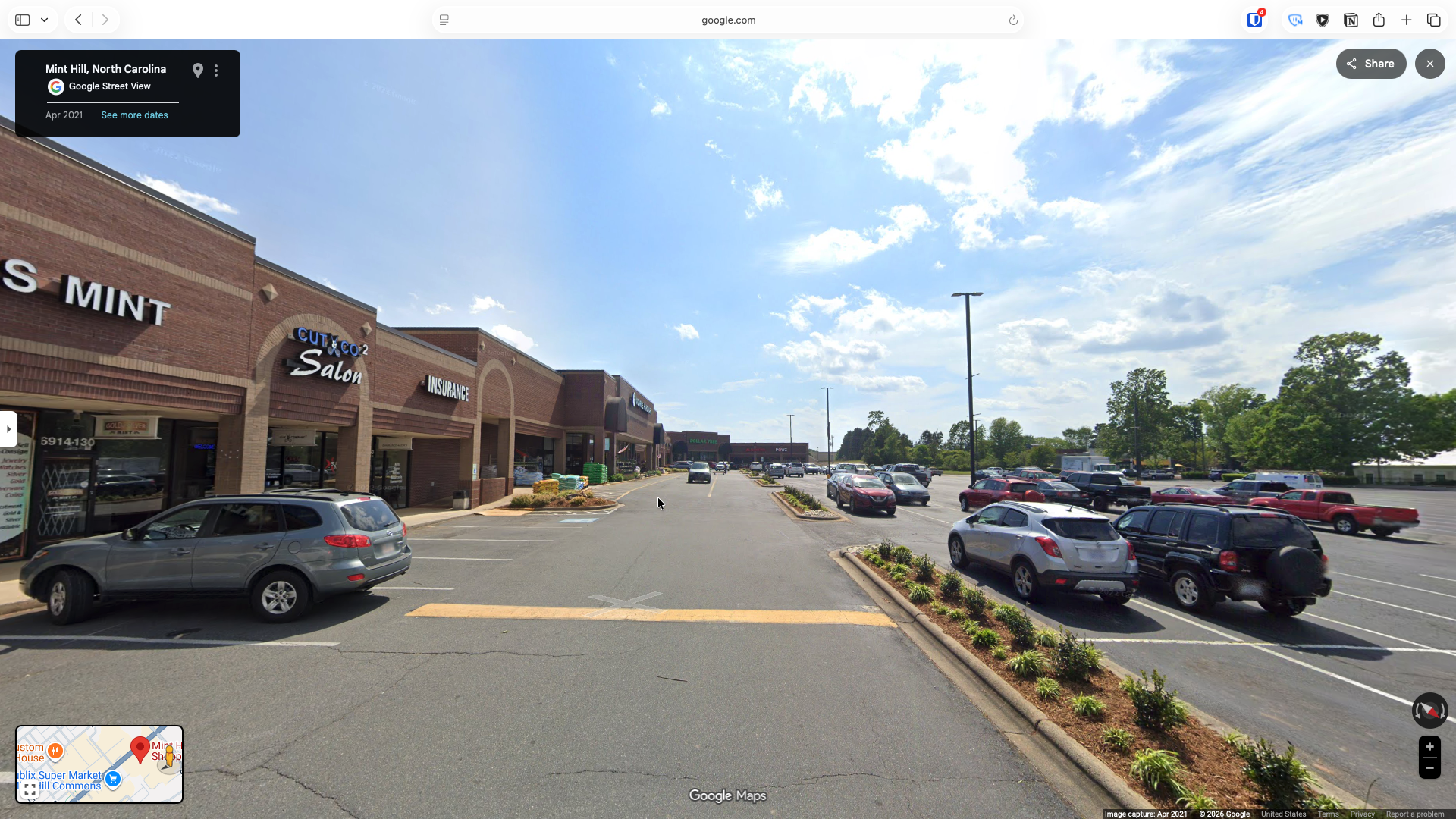
I’ve never liked strip malls, but for a long time I couldn’t quite explain why. The buildings themselves aren’t especially offensive. If you strip away the context, a strip mall is not so different from a row of shops that you might find present on a quaint walkable Main Street in a small town.
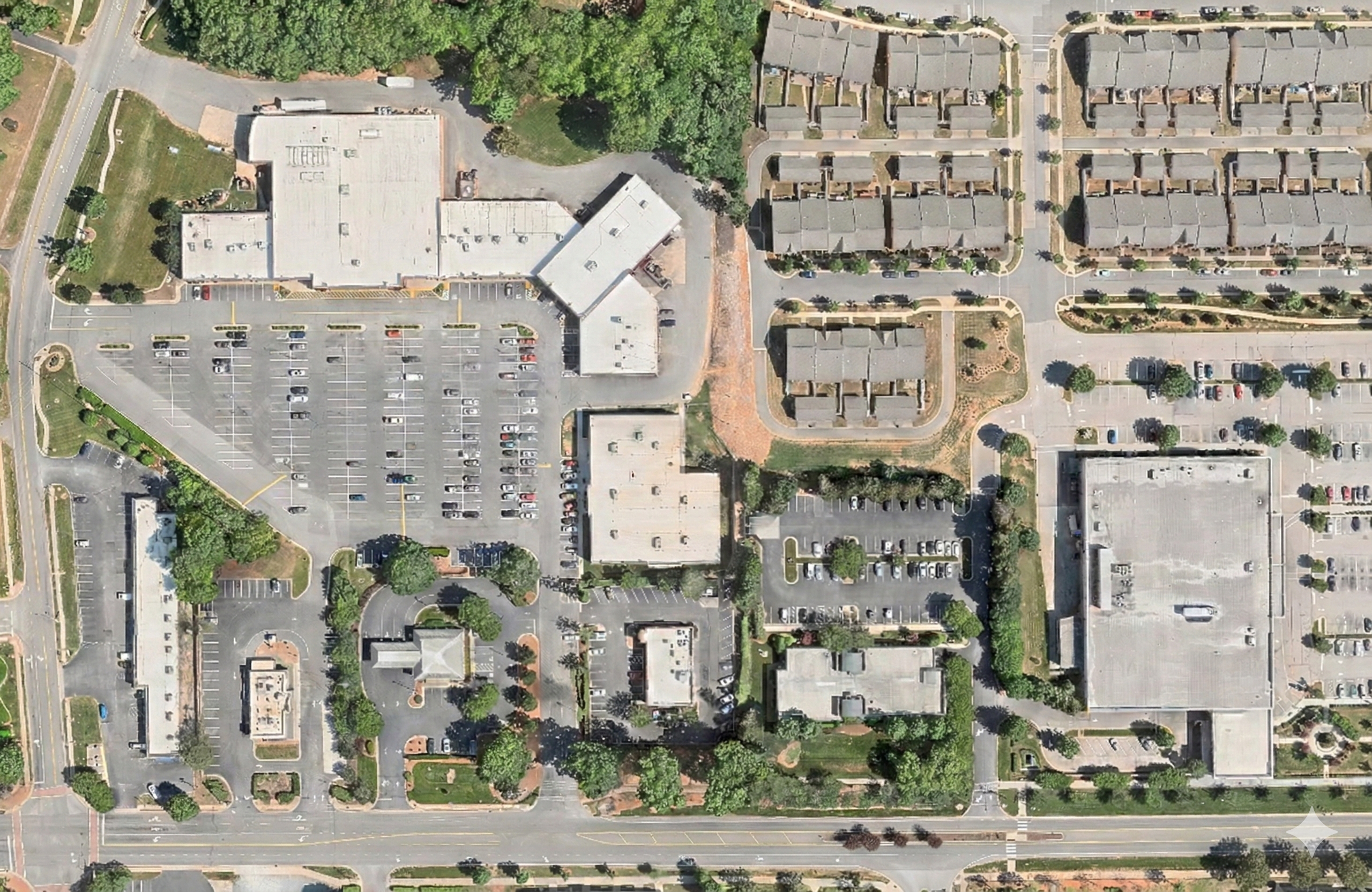
The problem is that unlike a main street, the strip mall is sitting behind an enormous moat of parking that makes it very difficult to get to for anyone not in a car. In order to reach the shops from the street you must cross a wide, hot, unshaded expanse of asphalt which is quite unpleasant.
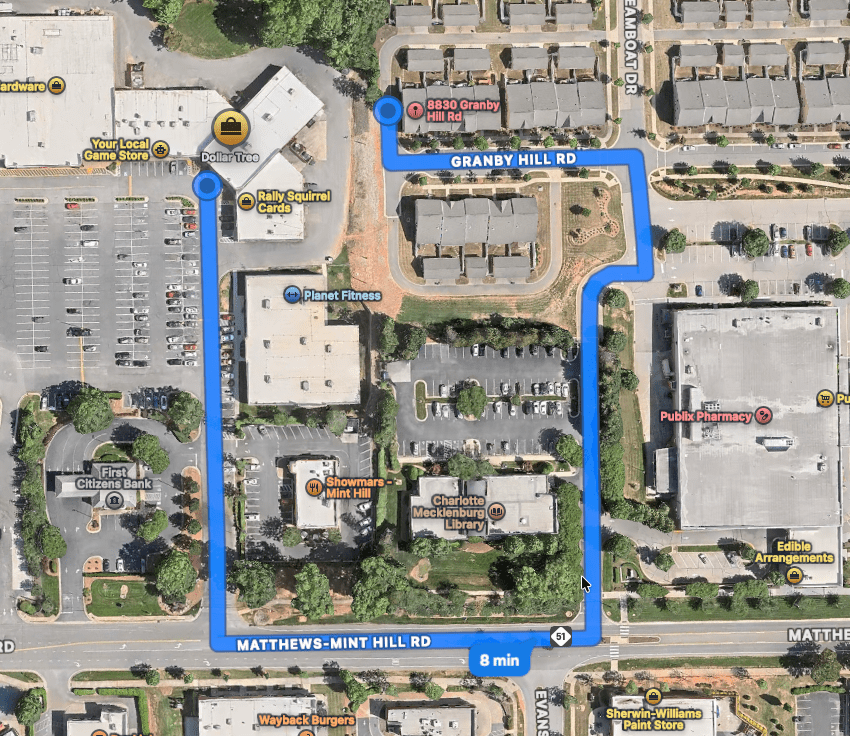
They’re also usually separated from housing. Even when homes are physically close, they’re rarely connected in a way that makes walking easy. For example, take a look at this typical American strip mall located in Mint Hill, NC with a residential development less than 50 feet away. However, because there is no pedestrian connection between the two places the official walking route is nearly half a mile and requires walking along a busy road.
So almost everyone arrives the same way: by car, which then sits in that giant parking lot until they leave.
The assumption that every visitor must store a private vehicle on site for the duration of their visit is what drives the need for dedicating so much land to car parking.
But that assumption may begin to change over the coming decade.
We are seeing rapid improvements in autonomous vehicles from companies like Waymo, such that I think there is a good chance private vehicle ownership may give way to robotaxis if they can be made cheaper per mile.
If people increasingly rely on on-demand transportation, especially autonomous vehicles, destinations won’t need to dedicate vast areas to parking. A vehicle could drop someone off and leave. The site would only need enough space to stage a limited number of robotaxis so that departures are reasonably quick. That’s very different from storing approximately one vehicle per person in the building.
And once you stop designing around having space to store one car for every person, a lot of land becomes available for other more productive uses.
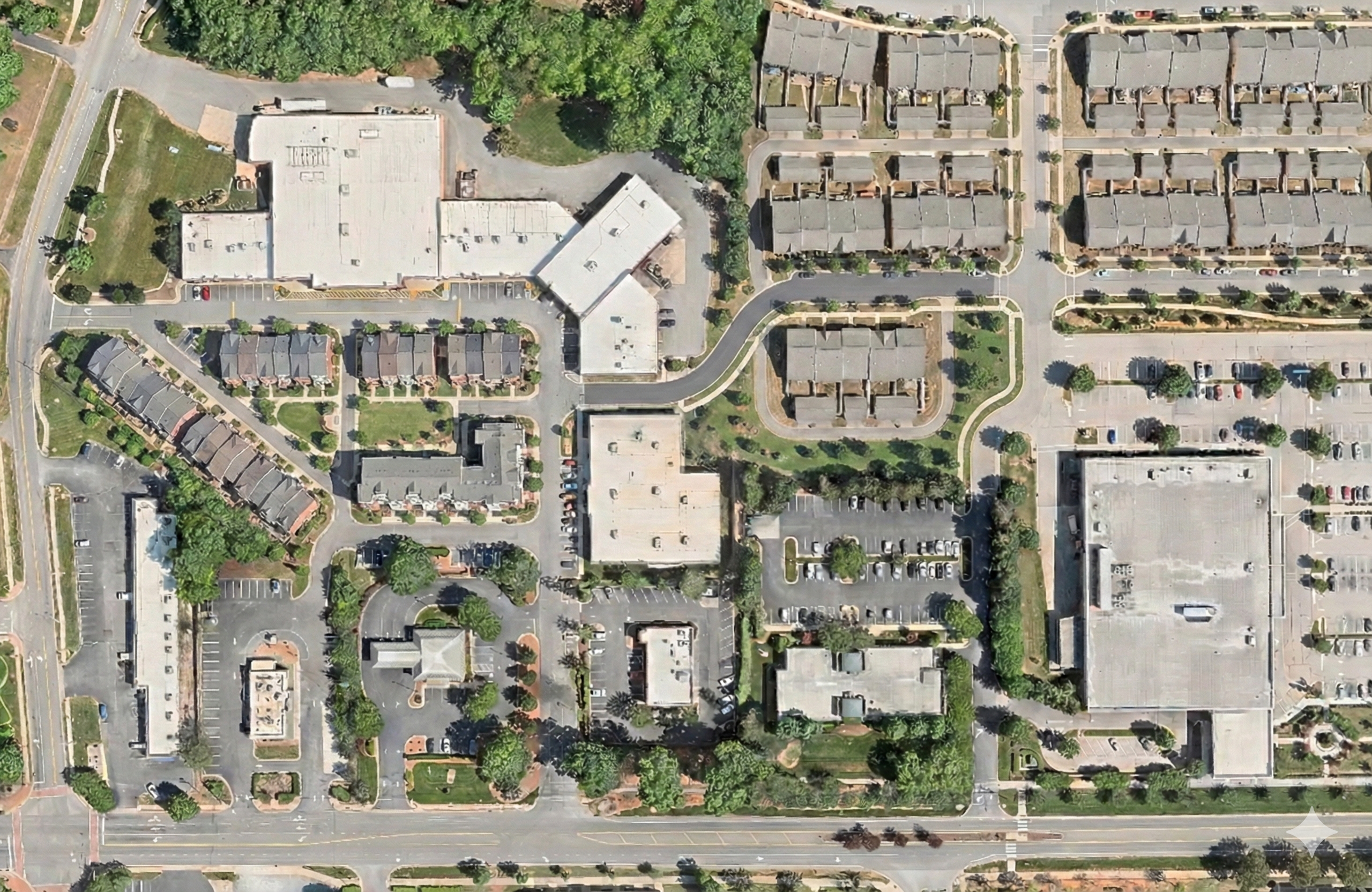
I would suggest that we should build infill housing on disused shopping center parking lots.
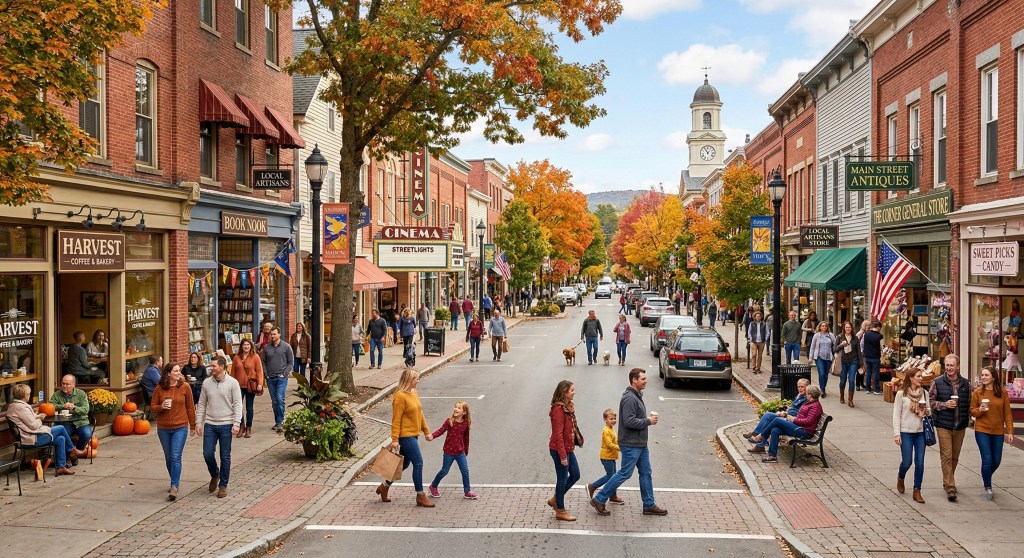
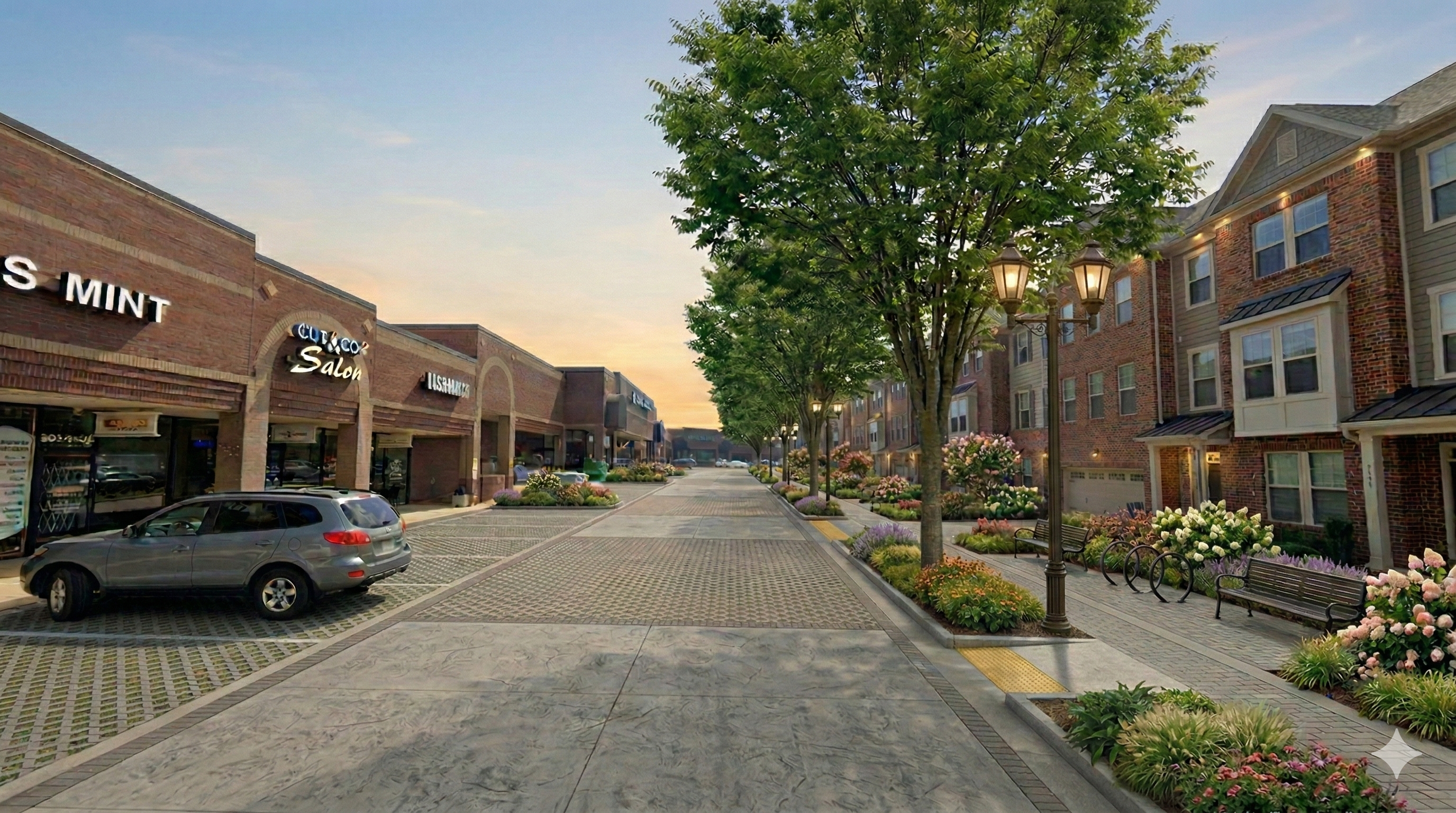
If most of the parking lot were replaced with townhomes, and perhaps a small apartment building, the character of the place would change immediately for the better. The bland soulless strip malls of modern day suburbia would be transformed into the cozy pleasant Main Streets of the past and become a place people actually want to spend time.
Take the strip mall that I mentioned earlier from Mint Hill, it has a general store, a small hardware store, a pizza place, a nail salon, a hair cutter, a gym, and a specialty shop or two. These are everyday businesses that are actually useful to live near. Being able to walk to get a haircut or pick up a few household items would be convenient.
Yet the layout makes living near them awkward or impossible.
Instead of a field of parked cars, imagine a shaded street lined with homes. Doors and windows facing the shops. A small green space tucked between buildings. Paths connecting to adjacent neighborhoods that currently sit cut off by massive six lane stroads (wide, high-speed arterial roads).
A short, direct link to the existing nearby townhome neighborhood would make the shops part of the neighborhood instead of a separate island. Residents could walk over in a few minutes instead of driving around to the main entrance.
People coming from farther away could still arrive by car, autonomous or otherwise, or by transit.
This kind of infill would make bus service along arterial roads more practical. Strip malls are usually located on major corridors. If housing filled in the parking lots along those corridors, there would be more people within walking distance of each transit stop and more destinations clustered together. For transit riders, the modern-day torturous walk across an expanse of hot asphalt with the sun beaming down on you, would be replaced with a pleasant stroll through tree lined neighborhood streets with shaded sidewalks.
By adding this infill housing we can also help alleviate the issues that many cities in the U.S. are experiencing with regard to a housing shortage in the parts of the city where people want to live. Many regions are short on homes, yet large portions of urbanized land are devoted to parking that sits partially empty much of the time. Reusing that space for housing adds units without expanding outward. It places residents close to daily needs. Some vehicle trips disappear entirely because they can be done on foot.
The underlying strip mall structure isn’t inherently flawed. It’s adaptable. What makes it unpleasant is the dominance of parking and the lack of integration with surrounding neighborhoods.
If the parking requirement shrinks, whether because of changing transportation patterns or different policy choices, the opportunity is straightforward. Build homes where the asphalt is. Connect surrounding neighborhoods to the shops. Let the existing storefronts function as a local town center rather than a drive-to outpost.
The difference between a hostile shopping center and a livable neighborhood might be less about architecture and more about what we decide to store on the land in front of it.