I spent the past weekend in Chicago, and really enjoyed it. I rode the L all over the city and made good use of the CTA buses, which honestly impressed me in their coverage. The trains mostly radiate outward from the Loop, so they’re not always ideal for cross-town travel, but the buses fill in those gaps really well.
I did the classic tourist things: the architecture boat tour, some deep-dish pizza, and some museums. It was a fantastic trip. But one thing stuck with me long after I left the city: Lake Shore Drive.
Chicago’s lakefront is stunning. There’s a long stretch of beaches and parkland along Lake Michigan that could be one of the greatest public amenities in the city. But instead of connecting the city to its shoreline, Chicago built an eight-lane highway through it.
Trying to walk from the downtown to the beach was surprisingly unpleasant. You head toward the lake expecting open access, only to hit a roaring wall of traffic. Lake Shore Drive is a barrier that you can hear and smell long before you reach the water.
There are pedestrian bridges and underpasses, but neither makes the experience of getting to the beach very pleasant. The underpasses are dim and uninviting. The overpasses require climbing stairs while being surrounded by noise and exhaust. Some sections allow you to cross at street level, but those crossings feel unsafe and out of place. No one enjoys darting across eight lanes of traffic.
This is public land that should bring people to the water, yet it’s dominated by cars. It’s a waste of beautiful real estate and a missed opportunity to create something extraordinary.
Seattle’s redeveloped land where the Alaska way highway used to run
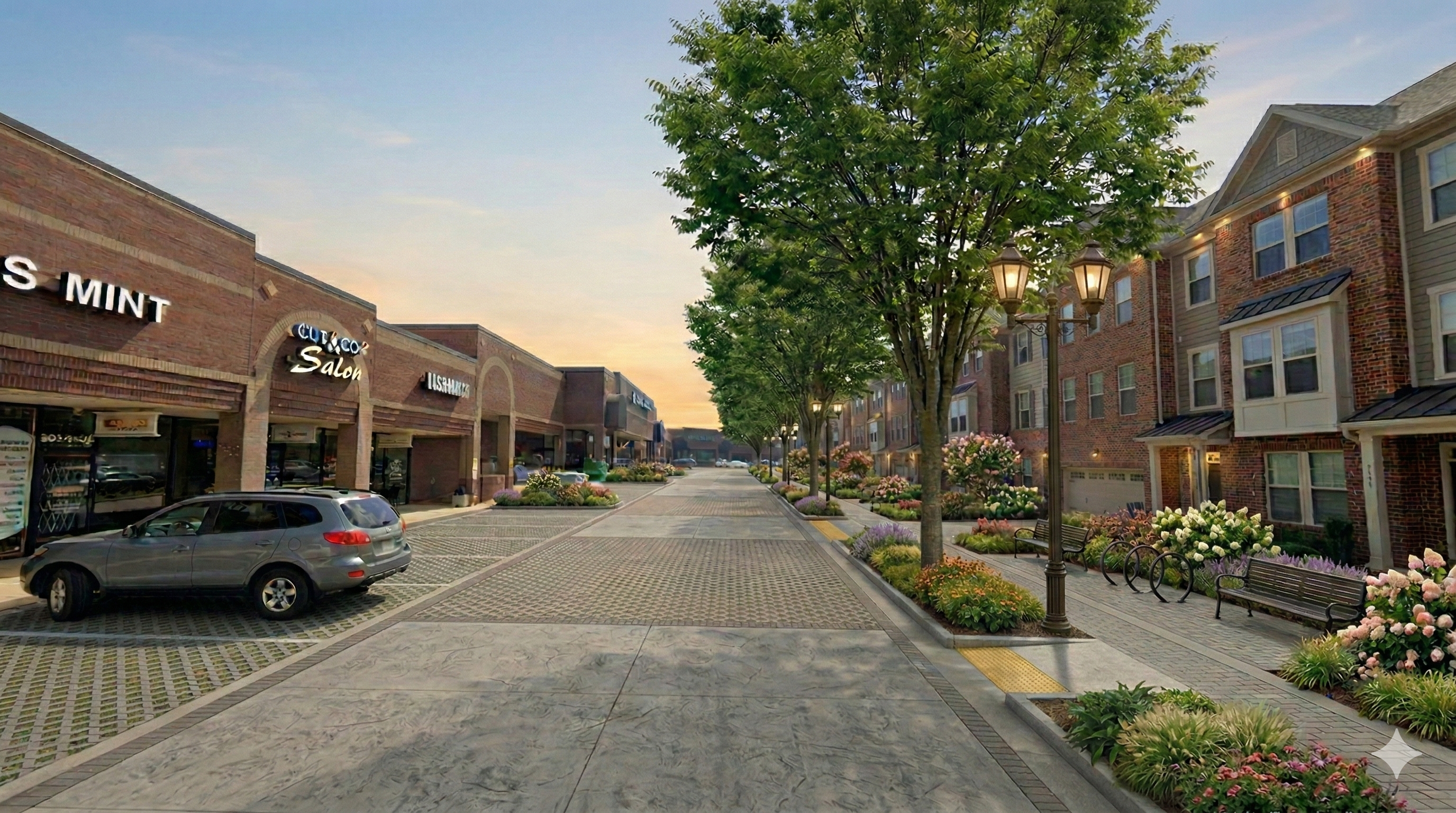
It reminded me of Seattle, which used to have a similar problem. The Alaskan Way Viaduct once separated downtown from the waterfront, but the city finally removed it and replaced it with a surface boulevard. Now the area has bike lanes, wide sidewalks, a pedestrian plaza, playgrounds, and even a park that connects Pike Place Market to the waterfront. It’s inviting, vibrant, and alive. It shows what Chicago’s lakefront could be.
I know it’s radical to suggest removing a major highway, but imagine what could be done if Lake Shore Drive were rethought entirely. What if it were buried underground, capped with a park, or replaced with a smaller road, perhaps just a transit corridor with bus lanes and bike paths? The buses that use it now could still run, but the space above could belong to people again.
Right now, Lake Shore Drive is noisy and polluted, and it physically cuts the city off from one of its greatest treasures. It doesn’t have to stay that way. Seattle showed what’s possible when a city decides that access to its waterfront matters more than preserving a mid-century traffic pattern.
Someday, I hope Chicago finds the political will to do the same. The city should tear down that barrier and reconnect its people to the lake. Residents deserve to enjoy their shoreline without having to cross a freeway to reach it.
I was recently heading out to dinner with my girlfriend at a restaurant in one of Charlotte’s suburbs. Before I left, I checked the transit options and noticed there was an express bus that went straight from Uptown, near my apartment, to a stop only about half a mile from the restaurant. Perfect.
The timing lined up almost exactly with our reservation. The bus would get me there about fifteen minutes early, which seemed like plenty of time to walk the short distance to the restaurant. It was only half a mile away, which should take no more than ten minutes on foot.
At least, that’s what I thought.
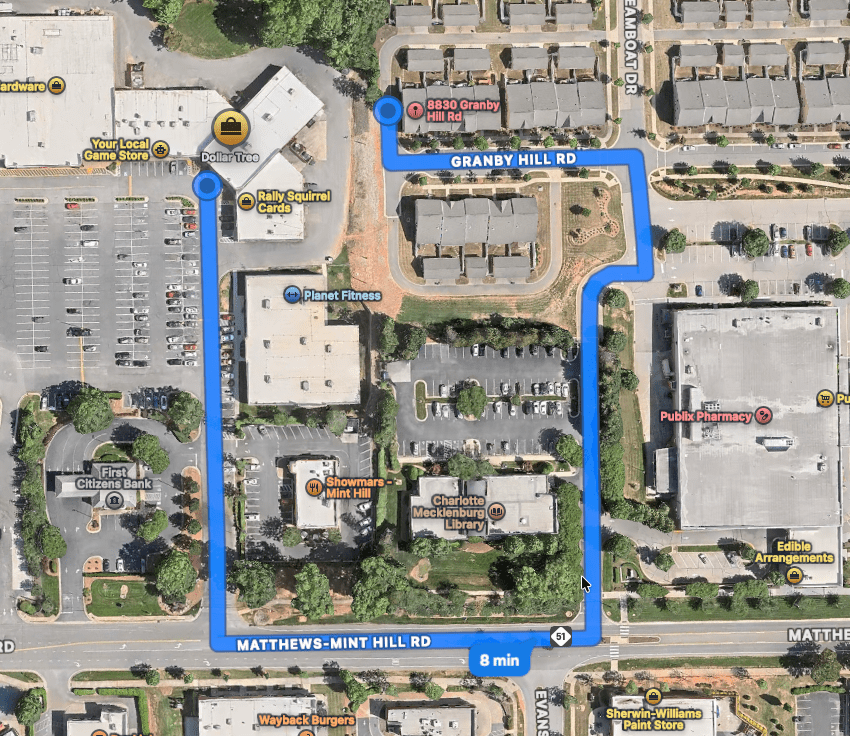
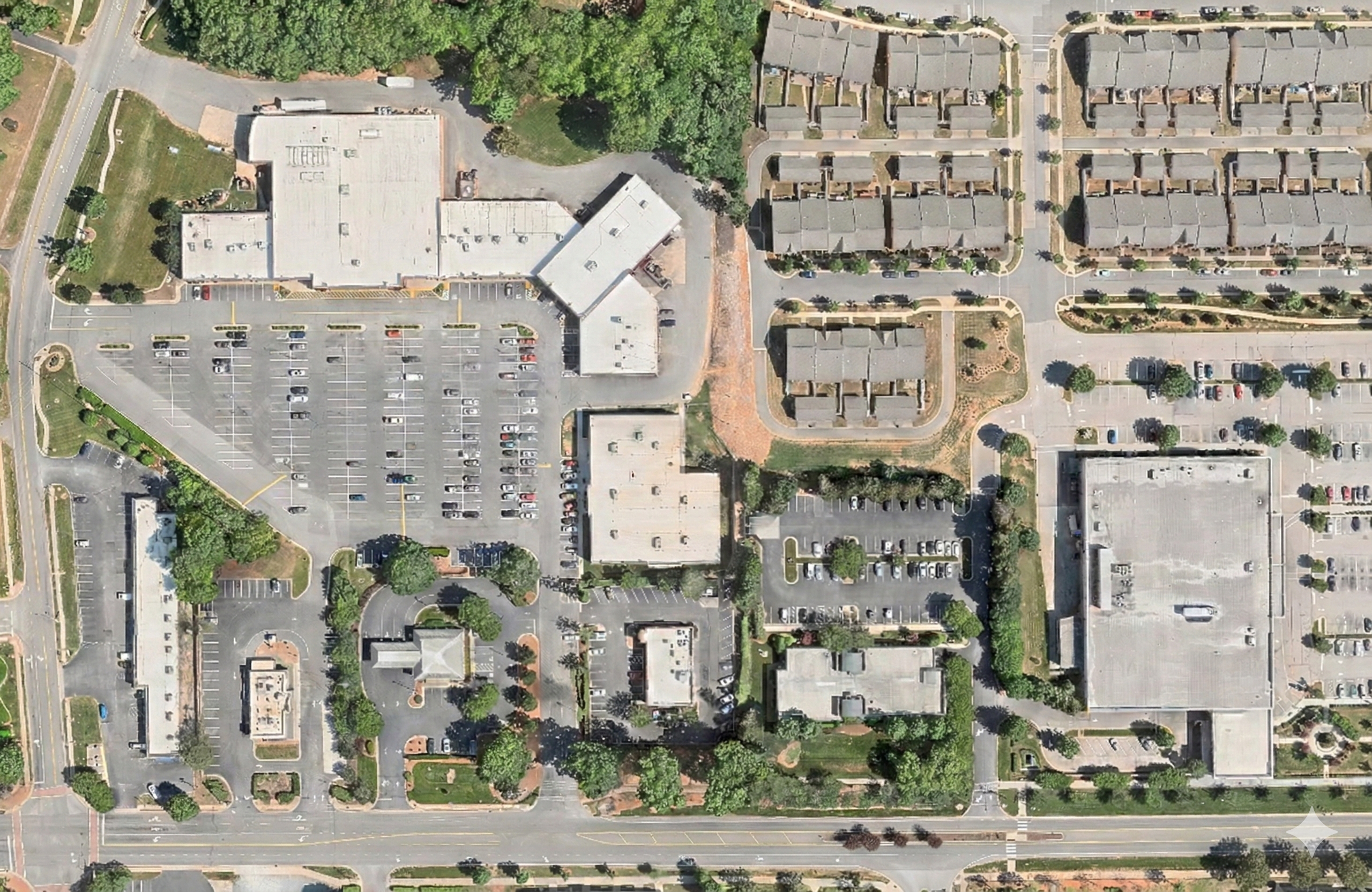
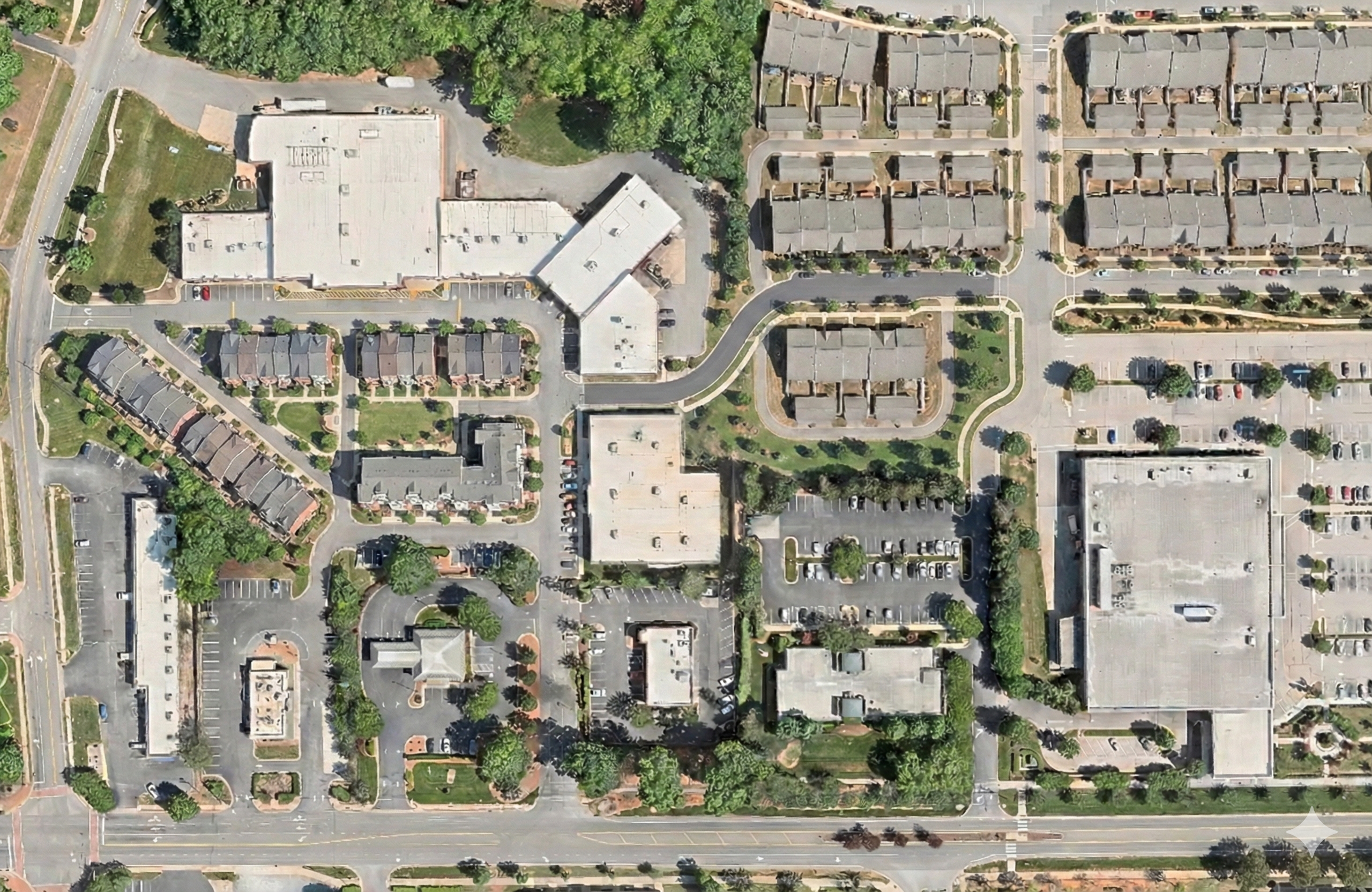
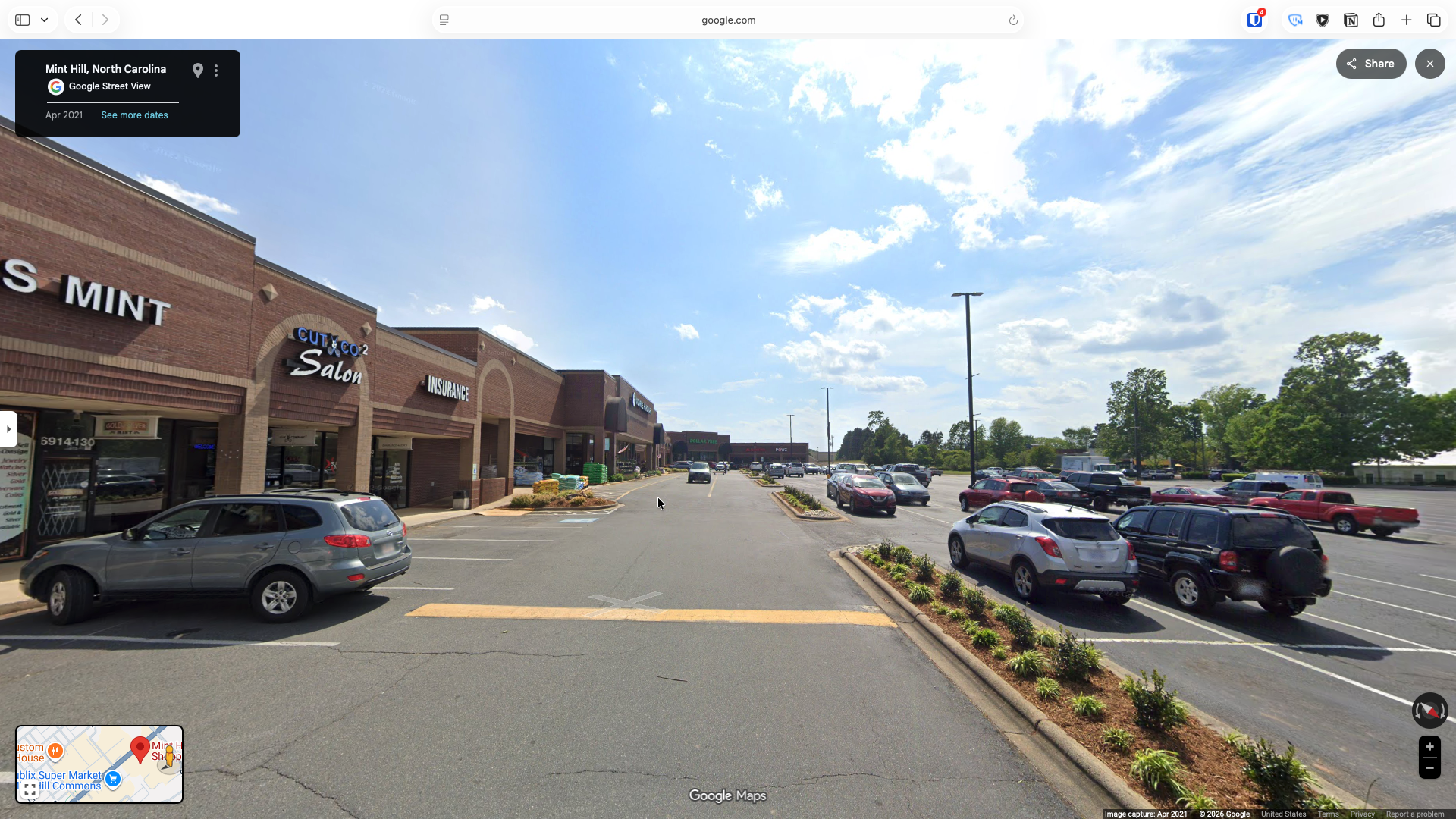
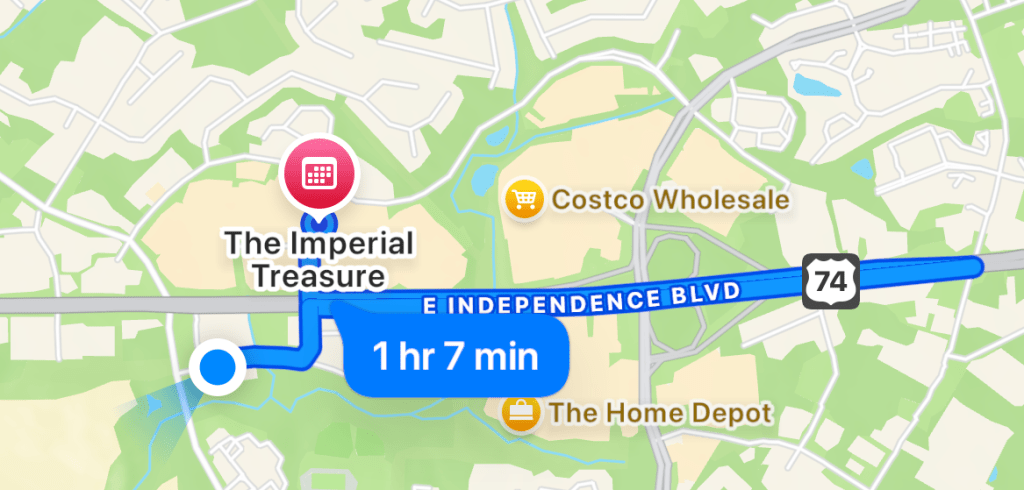
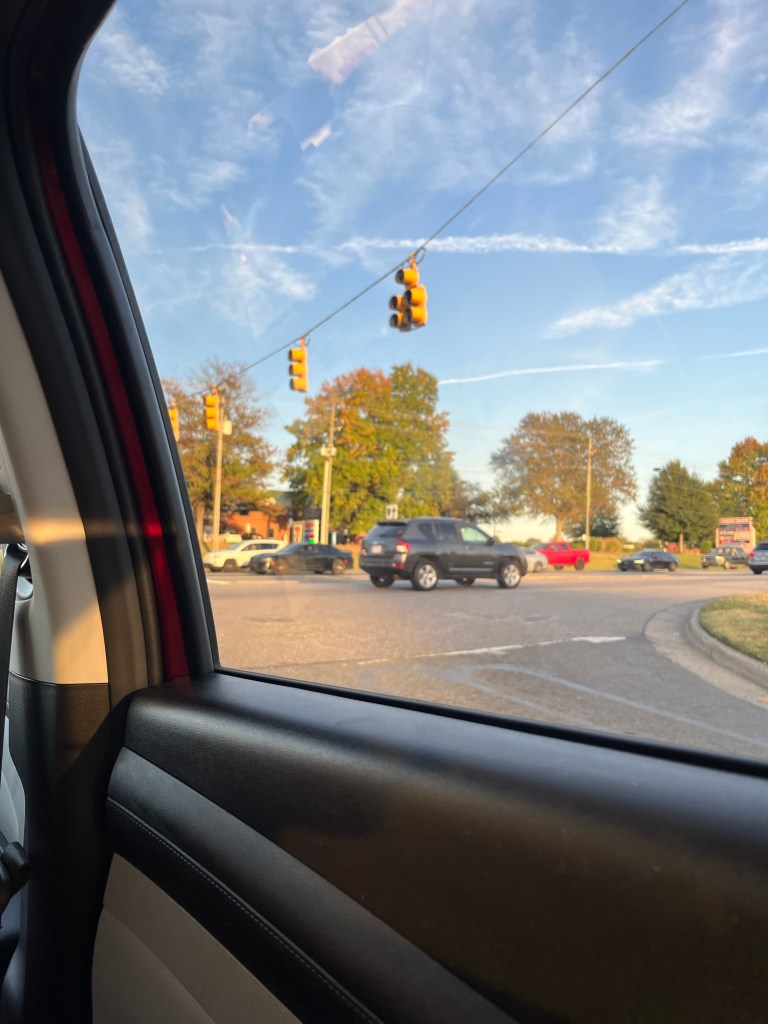
When I got off the bus, I opened the map and had a sudden realization: there was no way to cross the street. The “street,” as it turned out, was an eight-lane arterial road with traffic moving around fifty miles per hour. In other words, a classic American stroad.
Looking at the map more closely, I saw that the nearest crosswalk was about one and a half miles away. So to reach the restaurant legally, I would have had to walk a mile and a half to that crosswalk, then another mile and a half back on the other side. And as if that weren’t absurd enough, the entire route lacked sidewalks.
In total, that would have been a three-mile trip to cover what was, in a straight line, about two-hundred feet. Apple Maps estimated it would take an hour and seven minutes.
This was not what I expected, and I definitely didn’t have an hour to spare. So I had two choices: jaywalk across an eight-lane stroad, or hail a ride.
Jaywalking wasn’t an option. Between the speed of the cars and the lack of any safe refuge in the median, I would’ve been taking my life into my own hands. So I pulled up the app and ordered a car.
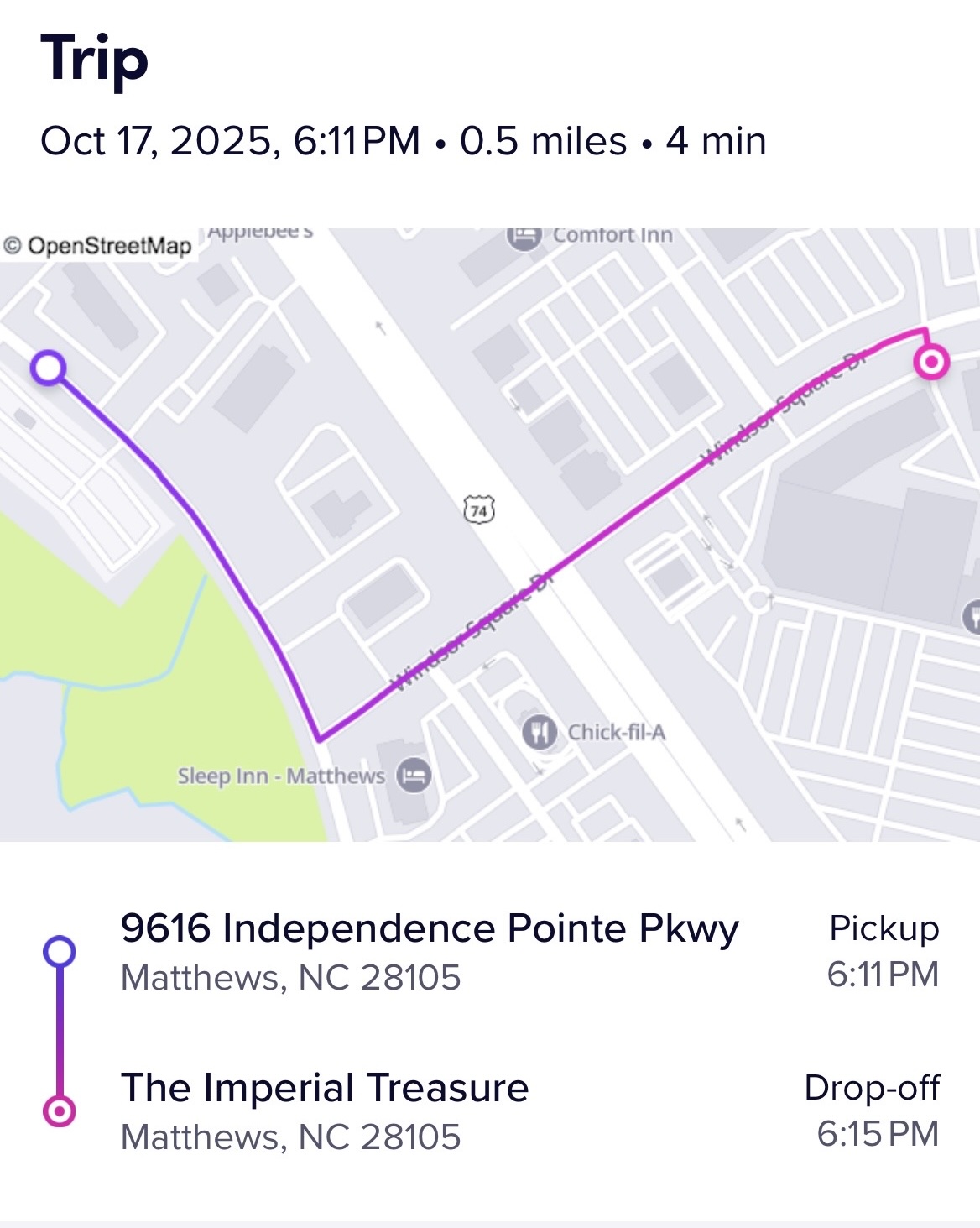
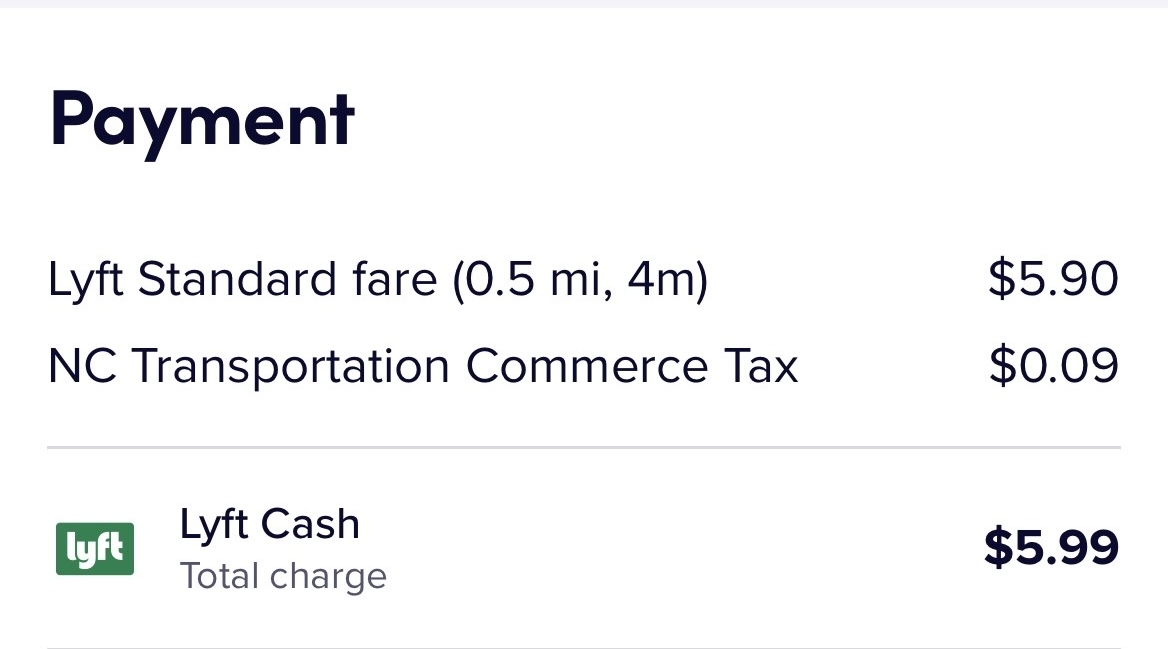
Ten minutes later, a Lyft picked me up and drove me across the street. The ride cost five dollars.
What should have been a five-minute walk became a fifteen-minute ordeal that cost money and produced emissions. And by forcing me to summon a car to do something as simple as crossing the street, the design of the area made traffic worse for everyone else too. For the Lyft driver to reach me, he had to drive along the same congested, rush-hour road, adding one more car to an already overloaded system. After picking me up, he drove me across the street, dropped me off, and then merged back into that same stream of traffic, slowing down all the other drivers just a little more because there was no safe way to walk.
This isn’t just an inconvenience. It’s an example of how poor street design isolates transit riders and pedestrians while making traffic worse for motorists. The city provided a bus that went right to where people might want to go, but the surrounding infrastructure made it functionally useless.
If Charlotte wants to be a city where people can move around without a car, it needs to do more than run buses. It needs to connect those buses to sidewalks, crosswalks, and safe, human-scaled streets.
Because no one should ever have to pay five dollars and wait ten minutes just to cross the street.
We like to think of car crashes as the fault of individual drivers. Someone was distracted, drunk, careless, or reckless. But I don’t think that’s the full story. I think the real blame belongs to the people who designed the cities that make driving the only option in the first place.
City planners and traffic engineers know that not everyone is good at driving. They know that some people have medical conditions, slower reflexes, or just aren’t equipped to operate heavy machinery safely. They know this, and yet they’ve built entire societies around the assumption that everyone can and must drive a car.
So when someone who’s not a great driver gets into a car and causes an accident, who is really at fault? Is it the person who made a mistake, or the people who designed a city where that person had no choice but to drive?
If you’ve created a system where the only way to get to work, school, or the grocery store is to operate a two-ton machine at highway speeds, knowing full well that not everyone can do that safely, then you are responsible for what happens next. You can’t act surprised when the predictable becomes reality.
Even “safe” roads in America are not truly safe. Engineers brag about wide lanes, big medians, guardrails, and bright signage. They call it “forgiving design.” But you can’t “forgive” the fact that every trip still requires people to pilot deadly machinery at lethal speeds.
Every hour of every day, someone dies in a car crash. And we call them “accidents,” as if they were random or unavoidable. But they’re not random. They’re built into the design. The engineers who made these roads could tell you exactly how many people will die on them each year. They run those models. They know the numbers. And they build them anyway.
Drunk driving is the perfect example of how our urban design fails us. Nobody is saying people should drink and drive. But when it’s common, that’s a symptom of terrible planning.
If someone wants to have a few drinks, they should be able to do that without risking their life or anyone else’s. In most American cities, that’s not possible. You drive to the bar because there’s no other option. You can’t walk because there’s no sidewalk. You can’t take a bus because it either doesn’t exist or stops running early in the evening. You could take an Uber, but that’s expensive. So people rationalize. “I’ve only had one or two. I’ll be fine.”
And here’s the kicker: cities require bars to have parking lots. They literally make it illegal to open a bar without providing a place for people to park their cars. They are mandating a system that encourages drinking and driving. Then they turn around and lecture us not to do it. It’s absurd.
Meanwhile, in Europe, you can walk to a bar. You can take a tram home. You can go out, drink, and get home safely. The safe option is also the convenient one. In America, the safe option barely exists.
Here, if you don’t want to drive, you’re out of luck. You either pay for expensive rideshares or risk walking along a strode with no sidewalk. So people drive, even when they shouldn’t. And when something goes wrong, we blame them.
But the truth is, most of these “bad drivers” are just doing what the system forces them to do. They’re acting rationally inside a setup that makes the rational thing dangerous.
Traffic engineers like to say they’re just following orders. “The city told us to widen the road, so we widened it.” But that’s not good enough. If someone told them to build a bridge they knew would collapse, would they do it? Would they sign off on something they knew would get people killed?
Of course not. Yet they do it all the time with roads. They sign off on stroads that they know will lead to hundreds of deaths a year. They approve designs that make walking, biking, and transit impossible. They don’t want to kill anyone, but they don’t care enough to stop. And that indifference is deadly.
When someone dies in a car crash, we talk about personal responsibility. But we almost never talk about the people who built the environment that made that crash inevitable.
Drivers might hold the steering wheel, but it’s the planners and engineers who paved the road, set the speed limits, banned mixed-use zoning, and made driving mandatory. The blood isn’t only on the drivers’ hands. It’s on the people who built a system that forces everyone to do something dangerous just to live their lives.
If we actually want to stop the death and destruction, that’s where we need to start looking.
Every time we hear about a tragic car crash, the story is usually framed around individual blame. Someone made a mistake, someone wasn’t paying attention, or someone was reckless. But beneath these headlines lies a harder truth. Our urban design itself creates the conditions for these deaths. Poor urban planning is not just an inconvenience or an aesthetic misstep. It is a public health crisis that costs lives every day.
In too many American cities, Charlotte included, roads are engineered like highways. They are wide, fast, and hostile to anything but cars. Corridors such as Independence Boulevard prioritize vehicle flow over human life, encouraging high speeds and leaving pedestrians and cyclists exposed. In this environment, even a brief lapse of focus, just a few seconds, can turn a mistake into a tragedy.
Accident on Independence Boulevard, Charlotte NC injuring 6 people
Just a few hours ago, as I write this post, there was an accident on Independence Boulevard that sent six people to the hospital, one with severe life-threatening injuries. It is tempting to place all of the blame on a driver going too fast. The harder truth is that the driver was simply responding to incentives created by reckless city planning, such as wide lanes, high speed limits, and a lack of safe transit alternatives. If the road had been designed to slow speeds and protect people, it is likely this crash would not have been so devastating or have happened at all.
And incidents like this are far from rare. The Charlotte-Mecklenburg Police Department website listed seven similar traffic events in just the past three hours alone.
To err is human. Every driver will make mistakes behind the wheel, such as misjudging a turn, glancing at a phone, or reacting a second too late. A safe transportation system recognizes this reality and builds in forgiveness. Narrower lanes, slower speeds, and protective infrastructure can ensure that a mistake does not automatically mean death. But our current design does the opposite. It demands flawless driving from every user, every second. That is not just unrealistic. It is negligent.
There is another layer to the problem. Many people simply should not be behind the wheel of heavy machinery. Teenagers, seniors, those with medical conditions, or people who are poor drivers are still forced to drive because cities have left them with no alternatives. By designing systems where car travel is the only viable option, we compel people into dangerous situations that put their lives and the lives of others at risk.
The spread-out, car-dependent development pattern of low-density housing, long commutes, and seas of parking creates endless demand for driving at higher speeds. Strong Towns and other urbanist voices have long warned that this model is both financially unsustainable and physically dangerous. More driving leads to more crashes, and higher speeds lead to more fatalities. The math is simple, and it is killing us.
If we want fewer deaths, we must stop pretending this is about individual failure. Real safety comes from systemic change.
Slower streets with narrower lanes, traffic calming, and enforced lower speed limits.
Safe alternatives such as protected bike lanes, sidewalks, and reliable public transit.
Walkable, mixed-use communities where housing and jobs are close together, reducing the need to drive.
Equitable design that prioritizes vulnerable road users and invests in underserved communities.
We call crashes “accidents” as if they were unavoidable acts of fate. They are not. They are predictable outcomes of policy choices, zoning codes, and street designs. Every fatal crash reflects a system that refuses to put people’s lives above the convenience of cars.
Poor urban planning kills. With better choices and people-first design, we can build cities where human mistakes no longer cost human lives.
Have you ever noticed how, as you grow older, the years seem to pass by more quickly? Many people share this experience, and it’s not just your imagination. This phenomenon can be explained by several psychological and neurological factors, with one particularly interesting explanation known as the Proportional Theory.
Understanding the Proportional Theory
The Proportional Theory suggests that as we age, each year represents a smaller proportion of our total life, making time feel like it’s accelerating. When you are young, a year is a significant part of your life. For instance, to a 10-year-old, a year is 10% of their life. However, to a 50-year-old, a year only accounts for 2% of their life. This shift in proportion is a key reason why time seems to speed up as we age.
A Formula for Perceived Life
To quantify this feeling, we can use a formula based on the harmonic series. This approach involves calculating the perceived percentage of your life that has been completed at any given age. Let’s break it down:
Proportional Contribution: Each year y represents 1 / y of your life at age y. The sum of these fractions up to your current age gives a measure of your perceived life.
Harmonic Series: The harmonic series is the sum of the reciprocals of the first n natural numbers. For our purpose, we sum the reciprocals of each year up to your current age.
Normalization: To get a meaningful percentage, we normalize this sum against the harmonic series sum up to an estimated lifespan, such as 80 years.
The Perceived Life Formula
Here’s how you can calculate the percentage of your perceived life completed at any age:
Where:
A is your current age.
L is the estimated lifespan (e.g., 80 years).
Let’s Do the Math
Let’s consider an example with a 24-year-old person, assuming an estimated lifespan of 80 years. The steps are as follows:
Calculate the harmonic sum up to age 24.
Calculate the harmonic sum up to the estimated lifespan of 80 years.
Normalize the harmonic sum of age 24 against the sum up to 80 years.
Running this formula gives us a perceived life percentage of approximately 76.04% for a 24-year-old. This means that, based on the Proportional Theory and our harmonic series approach, a 24-year-old feels as though they’ve experienced around three-quarters of their life’s perceived time.
Below is a table with the same calculation done for other ages.
Age
Life Expectancy
Perceived Life Percentage Completed
1
80
20.14%
10
80
58.99%
20
80
72.46%
30
80
80.46%
40
80
86.17%
50
80
90.61%
60
85
93.12%
70
90
95.09%
80
95
96.67%
90
100
97.98%
100
105
99.07%
Why This Matters
Understanding why time seems to fly by as we get older can have profound implications for how we choose to live our lives. Recognizing that our perception of time accelerates with age can encourage us to seek out new experiences, break out of routines, and make the most of each year, regardless of how quickly it seems to pass.
Final Thoughts
The Proportional Theory provides a fascinating lens through which to view our perception of time. By quantifying this perception, we gain insight into why our childhood summers seemed endless, while our adult years feel like they pass in the blink of an eye. Embracing this understanding can help us live more fulfilling lives, cherishing each moment as it comes.
In the video he argues that based on the historical data it is a bad idea to invest into exciting new technologies, and the companies that create them. Historically investors have overestimated the future growth of new innovative firms and underestimated how long it would take for dying industries to become irrelevant.
From 1900 through 2019, rail companies declined from a 63% share of the US stock market to a less than 1% share. It is the ultimate example of a declining industry. Over that time period, rail stocks beat the US market, road transportation stocks, and air transportation stocks.
To illustrate the point, Ben uses the example of the declining rail industry. Despite going from a 63% to 1% share of the stock market capitalization between 1900 and 2019, it still managed to outperform innovative new transportation technologies like cars and airplanes during the same time period.
Investors had overestimated how quickly the railway companies would become obsolete leading them to value those stocks too low. Similarly, they overestimated how well car and airplane companies would do causing those stocks to become overvalued and have lower returns.
The moral of the story is that great companies are not necessarily great investments if you pay too much for them, and when new technologies come out investors get excited and do just that. Additionally, bad companies could be good investments if you can get them cheap enough.
Since the approximate start of the age of information in 1971, the software industry has grown more than any other, from basically non-existent in 1971, to the largest industry by market capitalization at the end of 2019 at nearly 15% of the US stock market. The oil industry on the other hand has seen a massive decline in market capitalization, from nearly 15% of the US market in 1971, to about 3% at the end of 2019. Over this period, a dollar invested in the oil index grew to $134, while a dollar invested in the software index grew to $76.
A second example is that you would have made more money holding oil stocks instead of technology stocks over the time period between 1971 and 2019. Most likely investors are overestimating how quickly renewable energy will make oil obsolete leading to oil stocks being undervalued and having higher returns.
So counterintuitively, it seems like you’re better off investing in cheap dying stocks over expensive growth stocks. In other words, values stocks (those with low multiples) outperform growth stocks (those with high multiples). This is a well known phenomenon called the value premium and is the basis for value investing.
I really love podcasts. Not only do they provide great entertainment value as an alternative to audiobooks, but they are also one of the last open ecosystems on the web. Anyone can start a podcast by publishing an RSS feed on their website without having to rely on a central platform (thus nobody can “ban” your podcast). Once published listeners can consume their favorite podcasts from any RSS reader, including many specially made for podcasts like PocketCasts and Overcast.
This arrangement is beneficial to creators because it gives them full freedom of expression without having to worry about the censors on platforms like YouTube, and it gives them complete freedom of choice on how to monetize their work. It is equally beneficial to consumers who get to choose among hundreds of independently developed podcast apps to find the one with the best features for them. If a consumer wants to switch podcast players they can also do so while taking their subscriptions with them.
However, over the last few years Spotify has been making moves that could threaten this open ecosystem.
Later in 2019, Spotify acquired the podcast networks Gimlet Media, Anchor FM, and Parcast. However, they did not limit access to podcasts produced on those networks so users could still listen using their client of choice.
Extend
In May 2020, Spotify announced that it acquired an exclusive license to The Joe Rogan Experience (a popular comedy podcast) for $100 million dollars. Starting in September 2020, Joe’s podcast will be removed from all 3rd party podcasting apps and made available only in Spotify’s own podcasts section.
If the Joe Rogan license is a commercial success then it seems likely that the shows from the other podcast networks that Spotify owns will also be made exclusive to their own apps.
Extinguish
If Spotify chooses to continue on their current path of exclusive content it will break interoperability with other podcast apps and force listeners of those shows to use the Spotify podcast client. I suspect that many listeners will also transfer their existing subscriptions into Spotify to avoid needing two separate podcast clients.
If Spotify gains enough market share then it will effectively become the de facto gatekeeper of podcasts (similar to how Google Play is the de facto gatekeeper of Android apps despite side loading and alternative app stores). Once that happens many of the benefits of podcasts will be destroyed. Creators will no longer have full creative freedom as they risk annoying the Spotify censors and having a large portion of their audience taken away from them. Consumers will no longer have choice in podcast clients if they want to listen to shows that are exclusive to Spotify.
I really hope that Spotify’s attempt to centralize the podcasting ecosystem around their apps is a colossal failure, however, the Embrace, Extend, and Extinguish strategy is quite effective and thus I fear they may succeed.
As a small and feeble attempt to protest this direction that Spotify is moving I have decided to cancel my Spotify Premium subscription.
I was recently wondering which of the popular web search engines provided the best results and decided to try to design an objective benchmark for evaluating them. My hypothesis was that Google would score the best followed by StartPage (Google aggregator) and then Bing and it’s aggregators.
Usually when evaluating search engine performance there are two methods I’ve seen used:
Have humans search for things and rate the results
Create a dataset of mappings between queries and “ideal” result URLs
The problem with having humans rate search results is that it is expensive and hard to replicate results. Creating a dataset of “correct” webpages to return for each query solves the repeatability of the experiment problem but is also expensive upfront and depends on the human creating the dataset’s subjective biases.
Instead of using either of those methods I decided to evaluate the search engines on the specific task of answering factual questions from humans asked in natural language. Each engine is scored by how many of its top 10 results contain the correct answer.
Although this approach is not very effective at evaluating the quality of a single query, I believe in aggregate over thousands of queries it should provide a reasonable estimation of how well each engine can answer the users questions.
To source the factoid questions, I use the Stanford Question Answering Dataset (SQuAD) which is a popular natural language dataset containing 100k factual questions and answers from Wikipedia collected by Mechanical Turk workers.
Here are some sample questions from the dataset:
Q: How did the black death make it to the Mediterranean and Europe?
A: merchant ships
Q: What is the largest city of Poland?
A: Warsaw
Q: In 1755 what fort did British capture?
A: Fort Beauséjour
Some of the questions in the dataset are also rather ambiguous such as the one below:
Q: What order did British make of French?
A: expulsion of the Acadian
This is because the dataset is designed to train question answering models that have access to the context that contains the answer. In the case of SQaUD each Q/A pair comes with the paragraph from Wikipedia that contains the answer.
However, I don’t believe this is a huge problem since most likely all search engines will perform poorly on those types of questions and no individual one will be put at a disadvantage.
Collecting data
To get the results from each search engine, I wrote a Python script that connects to Firefox via Selenium and performs searches just like regular users via the browser.
The first 10 results are extracted using CSS rules specific to each search engine and then those links are downloaded using the requests library. To check if a particular result is a “match” or not we simply perform an exact match search of the page source code for the correct answer (both normalized to lowercase).
Again this is not a perfect way of determining whether any single page really answers a query, but in aggregate it should provide a good estimate.
Some search engines are harder to scrape due to rate limiting. The most aggressive rate limiters were: Qwant, Yandex, and Gigablast. They often blocked me after just two queries (on a new IP) and thus there are fewer results available for those engines. Also, Cliqz, Lycos, Yahoo!, and YaCy were all added mid experiment, so they have fewer results too.
I scraped results for about 2 weeks and collected about 3k queries for most engines. Below is a graph of the number of queries that were scraped from each search engine.
Crunching the numbers
Now that the data is collected there are lots of ways to analyze it. For each query we have the number of matching documents, and for the latter half of queries also the list of result links saved.
The first thing I decided to do was see which search engine had the highest average number of matching documents.
Much to my surprise, Google actually came in second to Ecosia. I was rather shocked with this since Ecosia’s gimmick is that they plant trees with the money from ads, not having Google beating search results.
Also surprising is the number of Bing aggregators (Ecosia, DuckDuckGo, Yahoo!) that all came in ahead of Bing itself. One reason may be that those engines each apply their own ranking on top of the results returned by Bing and some claim to also search other sources.
Below is a chart with the exact scores of each search engine.
To further understand why the Bing aggregators performed so well, I wanted to check how much of their own ranking was being used. I computed the average Levenshtein distance between each two search engines, which is the minimum number of single result edits (insertions, deletions or substitutions) required to change one results page into the other.
Of the three, Ecosia was the most different from pure Bing with an average edit distance of 8. DuckDuckGo was the second most different with edit distance of 7, followed by Yahoo! with a distance of 5.
Interestingly the edit distances of Ecosia, DuckDuckGo, and Yahoo! seem to correlate well with their overall rankings where Ecosia came in 1st, DuckDuckGo 3rd, and Yahoo! 5th. This would indicate that whatever modifications these engines have made to the default Bing ranking do indeed improve search result quality.
Closing thoughts
This was a pretty fun little experiment to do, and I am happy to see some different results from what I expected. I am making all the collected data and scripts available for anyone who wants to do their own analysis.
This study does not account for features besides search result quality such as instant answers, bangs, privacy, etc. and thus it doesn’t really show which search engine is “best” just which one provides the best results for factoid questions.
I plan to continue using DuckDuckGo as my primary search engine despite it coming in 3rd place. The results of the top 6 search engines are all pretty close, so I would expect the experience across them to be similar.
So I was recently asked why I prefer to use free and open source software over more conventional and popular proprietary software and services.
A few years ago I was an avid Google user. I was deeply embedded in the Google ecosystem and used their products everywhere. I used Gmail for email, Google Calendar and Contacts for PIM, YouTube for entertainment, Google Newsstand for news, Android for mobile, and Chrome as my web browser.
I would upload all of my family photos to Google Photos and all of my personal documents to Google Drive (which were all in Google Docs format). I used Google Domains to register my domain names for websites where I would keep track of my users using Google Analytics and monetize them using Google AdSense.
I used Google Hangouts (one of Google’s previous messaging plays) to communicate with friends and family and Google Wallet (with debit card) to buy things online and in-store.
My home is covered with Google Homes (1 in my office, 1 in my bedroom, 1 in the main living area) which I would use to play music on my Google Play Music subscription and podcasts from Google Podcasts.
I have easily invested thousands of dollars into my Google account to buy movies, TV shows, apps, and Google hardware devices. This was truly the Google life.
Then one day, I received an email from Google that changed everything.
“Your account has been suspended”
Just the thing you want to wake up to in the morning. An email from Google saying that your account has been suspended due to a perceived Terms of Use violation. No prior warning. No appeals process. No number to call. Trying to sign in to your Google account yields an error and all of your connected devices are signed out. All of your Google data, your photos, emails, contacts, calendars, purchased movies and TV shows. All gone.
I nearly had a heart attack, until I saw that the Google account that had been suspended was in fact not my main personal Google account, but a throwaway Gmail account that I created years prior for a project. I hadn’t touched the other account since creation and forgot it existed. Apparently my personal Gmail was listed as the recovery address for the throwaway account and that’s why I received the termination email.
Although I was able to breathe a sigh of relief this time, the email was wake up call. I was forced to critically reevaluate my dependence on a single company for all the tech products and services in my life.
I found myself to be a frog in a heating pot of water and I made the decision that I was going to jump out.
Leaving Google
Today there are plenty of lists on the internet providing alternatives to Google services such as this and this. Although the “DeGoogle” movement was still in its infancy when I was making the move.
The first Google service I decided to drop was Gmail, the heart of my online identity. I migrated to Fastmail with my own domain in case I needed to move again (hint: glad I did, now I self host my email). Fastmail also provided calendar and contacts solutions so that took care of leaving Google Calendar and Contacts.
Migrating away from Google was not a fast or easy process. It took years to get where I am now and there are still several Google services that I depend on: YouTube and Google Home.
Eventually, my Google Home’s will grow old and become unsupported at which point hopefully the Mycroft devices have matured and become available for purchase. YouTube may never be replaced (although I do hope for projects like PeerTube to succeed) but I find the compromise of using only one or two Google services to be acceptable.
At this point losing my Google account due to a mistake in their machine learning would largely be inconsequential and my focus has shifted to leaving Amazon which I use for most of my shopping and cloud services.
The reason that I moved to mostly FOSS applications is that it seems to be the only software ecosystem where everything works seamlessly together and I don’t have to cede control to any single company. Alternatively I could have simply split my service usage up evenly across Google, Microsoft, Amazon, and Apple but I don’t feel that they would have worked as nicely together.
Overall I’m very happy with the open source ecosystem. I use Ubuntu with KDE on all of my computers and Android (no GApps) on my mobile phone. I’ve ordered the PinePhone “Brave Heart” and hope to one day be able to use it or one of its successors as a daily driver with Ubuntu Touch or Plasma Mobile.
I don’t want to give the impression that I exclusively use open source software either, I do use a number of proprietary apps including: Sublime Text, Typora, and Cloudron.
If you’ve decided to move to another email provider it’s possible to take all of your old emails and folders with you. The easiest way I’ve found to do this is using the mail client Mozilla Thunderbird.
Thunderbird new account dialog. File > New > Existing mail account.
With Thunderbird installed, sign in to both your old and new emails accounts. This is provider dependent but in general if you are using a popular email service like Gmail, Yahoo, Outlook, etc. then Thunderbird can auto discover the SMTP endpoints. If you have two-factor authentication setup on your email account you may need to create an app password.
If you are unsure, here are the instructions for a few popular services:
When you set up your old account make sure you set Thunderbird to download the entire email history not just the last few months.
Account settings for you can set how many emails Thunderbird will download. Edit > Account Settings.
Once you are signed in to both accounts you should see all of your emails and folders in the old account. You may want to wait for Thunderbird to finish downloading emails if necessary.
To move emails, simply select the inbox of your old mail account, use Ctrl + A to select all the emails, then drag them to the new inbox. You will also need to drag each of the folders from the old email account to the new one.
If you’d like to just move a couple of emails you can select them individually and drag them to the new email account.