Category: Microblog
-
The relationship between college enrollment and tuition
I spent my evening determining a reasonable expected growth rate for future college tuition. The graph below displays the correlation between college attendance rates and tuition. While I’m not concluding causation from the data, it seems plausible that increased enrollment rates have led to higher tuition costs. With enrollment now peaking at around 100% and appearing to decline, I anticipate a lower future growth rate. The historical growth rate was approximately 6%, but I’m considering a rate closer to 2% going forward.
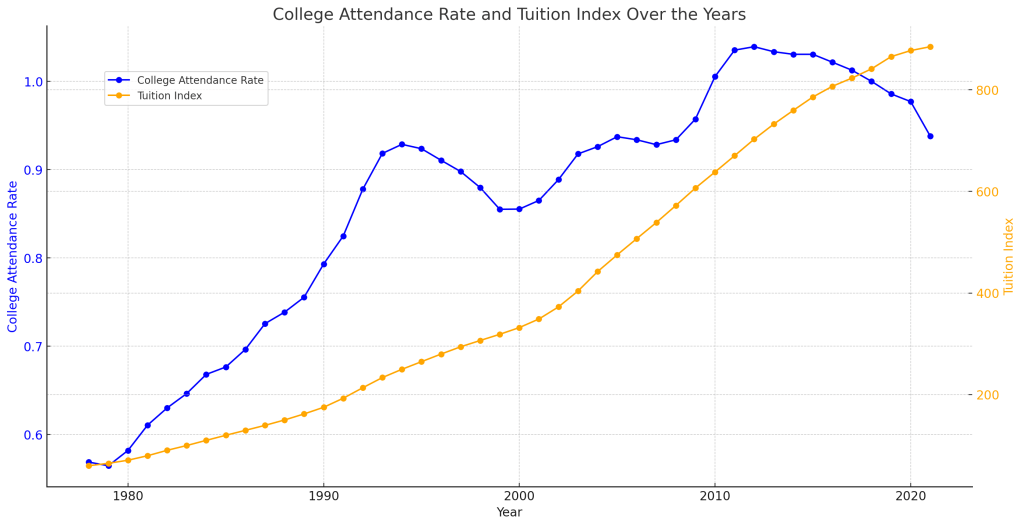
In the data attendance rate is defined as the number of people enrolled in college divided by the number of people aged 18-22 in the United States. -
Low Risk Stocks Should Have Higher Risk-adjusted Returns than the Market
- Leveraged constrained investors with high risk tolerance will invest more heavily in stocks that are riskier than the market
- Investors with a lower risk tolerance than the market can deleverage very cheaply by holding some combination of cash and TSM
- There is no reason for an investor seeking less risk than the market to invest in low beta stocks because they could instead just deleverage a portfolio with beta = 1.
- The only reason for someone to hold low beta stocks is if they offer better risk adjusted returns than the market
- If high beta stocks get bid up by leveraged constrained investors, then their risk adjusted returns will be worse than the market, consequentially low beta stocks must then have higher risk adjusted returns than the market
- If low beta stocks do have higher risk adjusted returns, there are limits to arbitrage because leverage is not free
- Low beta stocks should still underperform high beta stocks in absolute terms
-
How to make Office Online use OpenDocument format
Did you know that Microsoft Office online can use either Microsoft Office format (docx, pptx, xlsx) or OpenDocument format (odt, odp, ods)? I didn’t until a commenter pointed it out.
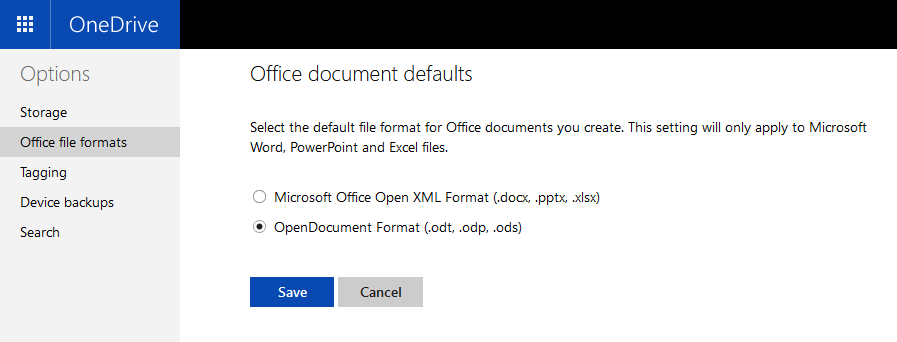
You can change the default file formats for Office documents from your OneDrive Settings. There is an option called Office file formats.
Yovko LambrevIf you visit the OneDrive settings on their website there is an option to change between the two formats.
Then if you create a new “Word document” by right-clicking in OneDrive
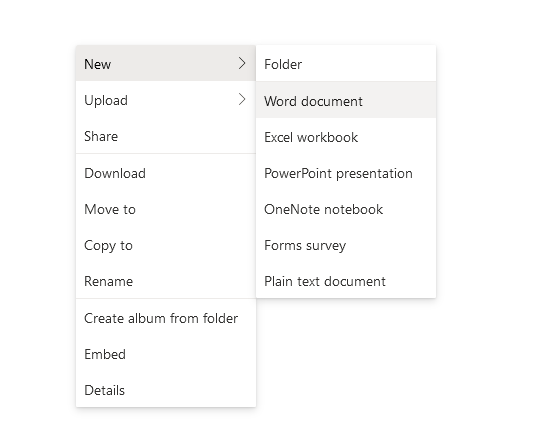
It’s actually a OpenDocument ODT file!
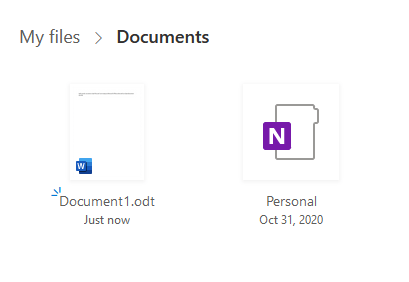
Then you can click on it to open it in Word online.

Pretty neat!
-
Switching to WordPress.com
For the past few years I’ve been hosting my blog on Linode, but I’ve decided to switch over to WordPress.com on their “Personal” plan since it was a bit cheaper.
So far everything seems to be working well, and I was able to migrate over all of the posts, pages, and comments from my previous WordPress installation. However, WordPress.com doesn’t support the www subdomain which is annoying, so I either have to make it the naked domain (kylepiira.com) or use another subdomain like blog.kylepiira.com. Right now, I’ve opted for the naked domain, although I think it looks much uglier than the version with www.
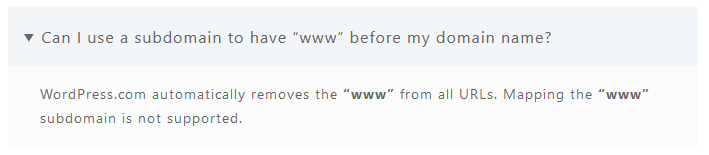
Typical web developers, breaking something that’s worked for the last 30 years in favor of the new hotness.
I also had to disable the AMP feature which is enabled by default by going through Settings → General → Performance.
-
Microsoft Office Online switches to OpenDocument as default format
So earlier today I was trying out Microsoft’s online office suite and noticed something interesting. Whenever you create a new Word, Excel, or PowerPoint file from the OneDrive interface, it automatically creates it using the OpenDocument file format (odt, ods, odp) as opposed to the Microsoft Office format (docx, xlsx, ppt). Interestingly if you create it from Office.com it uses the Microsoft format instead.


-
Switching to exFAT
I’ve decided that I’m going to be reformatting my 25 TB of external storage capacity (for storing datasets, backups, etc.) to exFAT. Most of it is currently ext4 or NTFS.
exFAT is great because similar to its predecessor FAT it has read-write compatibility with Linux, Windows, and macOS. But while FAT can only have files as big as 4 GB and partitions of 16 TB, exFAT can do 16 EB for files and 64 ZB for partitions. Lots more room to grow.
It’ll be a slow process since I can only format one drive at a time and need to copy the data to another drive and back again. So far I’ve converted 4 TB of data.
-
Jitsi open source video chat
So my university has shutdown the campus for the remainder of the semester due to Coronavirus concerns and asked all students to attend classes remotely (mainly using Zoom for live-streaming lectures). I went looking for an open source cross platform video conferencing solution with a fast onboarding process to keep in touch with fellow students and found Jitsi to fit the bill.
It’s free, it’s FOSS, and there are no accounts required to create a chat session on their website. You just need to enter a name for your room, and they give you a link to share for people to join.
The only officially supported web browser is Google Chrome which kinda sucks. But it seems to work okay in Firefox except I couldn’t get it to detect any of my microphones (your usage may vary). Instead, I’m using it in Falkon and it works flawlessly.
Unfortunately, it also doesn’t appear that video chats are end-to-end encrypted which means whoever runs the server can see the raw footage (but you can self-host).
Overall it’s good enough and it looks like the public service is hosted by 8×8, which is a public VoIP company, so I’m not overly concerned about eavesdropping (due to the lack of end-to-end encryption). I’ll keep an eye out for better options but for now I’m sticking with Jitsi.

 Kyle Piira