Tag: lyft

  • Is Uber or Lyft cheaper?

    I use ride-hailing apps fairly often, so I was curious whether Uber or Lyft is cheaper on average. To find out, I downloaded my complete ride history from both companies and compared what I paid across 477 trips.

    The short answer is that Lyft was cheaper most of the time. Across 340 Uber rides and 137 Lyft rides, Lyft had a lower aggregate cost per mile and per minute, and it was cheaper across every distance band.

    This is not a comparison of simultaneous quotes for identical trips. The rides took place at different times and in different locations, so the results describe my own experience rather than guarantee which app will be cheaper for any particular trip.

    The overall comparison

    To compare rides of very different lengths, I divided total spending by total miles and total travel minutes for each service. On that basis, Uber averaged $1.98 per mile and $1.03 per minute, while Lyft averaged $1.61 per mile and $0.93 per minute. That made Lyft about 19% cheaper per mile and 10% cheaper per minute.
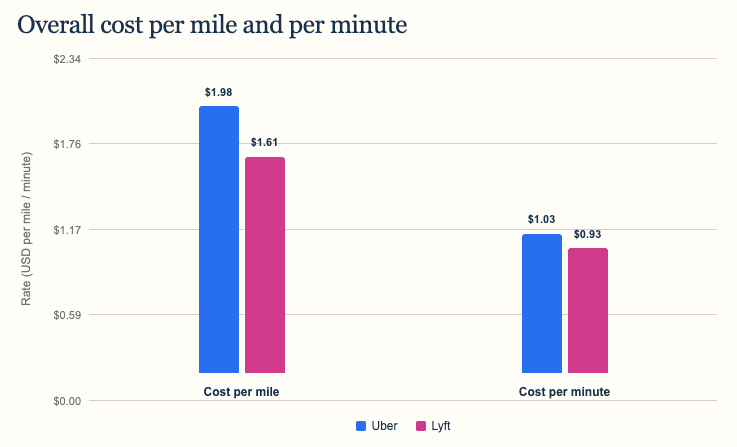
    Bar chart comparing Uber and Lyft aggregate cost per mile and cost per minute

    Aggregate rates are calculated as total cost divided by total miles or minutes, so each mile or minute carries equal weight.

    Short rides are expensive per mile

    Rides under five miles cost roughly $4.20 per mile on Uber and $3.87 on Lyft. Once trips reached 20 miles, those figures fell to about $1.58 and $1.35, respectively. Base fares and fixed fees get spread across more miles on longer trips.
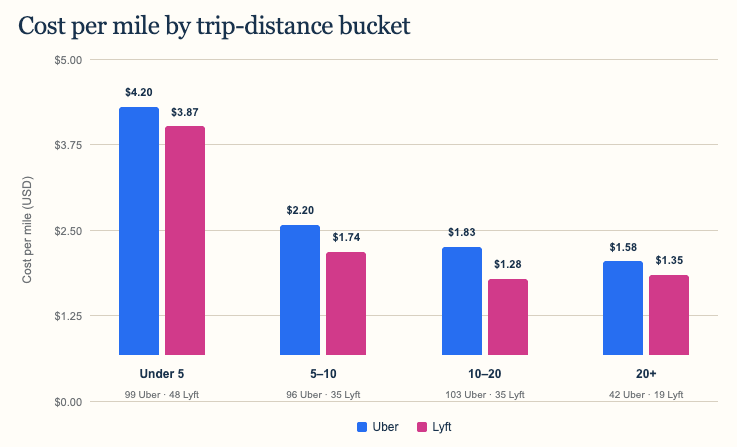
    Bar chart comparing Uber and Lyft cost per mile across four trip-distance bands

    Lyft was cheaper per mile in all four distance groups. Its advantage was modest for rides under five miles and for rides over 20 miles, but wider in the middle: Lyft cost about 21% less per mile for five-to-ten-mile trips and about 30% less for ten-to-twenty-mile trips.
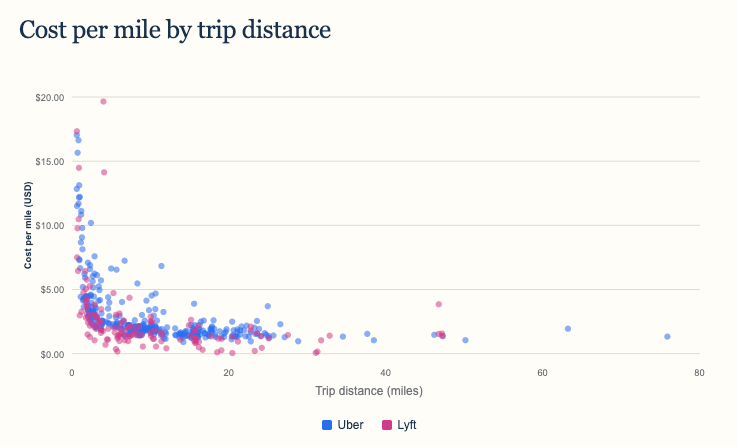
    Scatter plot showing cost per mile for individual Uber and Lyft rides by trip distance

    The individual rides show why an average only tells part of the story. Prices vary widely on short trips, while longer rides cluster into a narrower cost-per-mile range. Surge pricing, fees, location, and ride type can easily overwhelm the average on any single booking.

    The comparison by trip duration

    Cost per minute also generally declined as rides got longer. Lyft was cheaper in the first three duration groups: under 10 minutes, 10–20 minutes, and 20–40 minutes. The largest gap appeared in the 20–40 minute group, where Uber averaged $0.99 per minute versus $0.72 for Lyft.
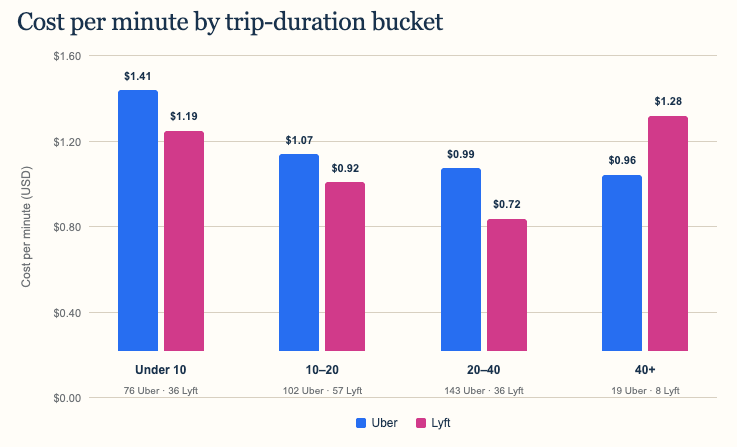
    Bar chart comparing Uber and Lyft cost per minute across four trip-duration bands

    Uber reversed the result for rides lasting 40 minutes or more, at $0.96 per minute compared with $1.28 for Lyft. That result needs extra caution, however: the group contains only 19 Uber rides and eight Lyft rides, so a handful of unusual fares can move the average substantially.
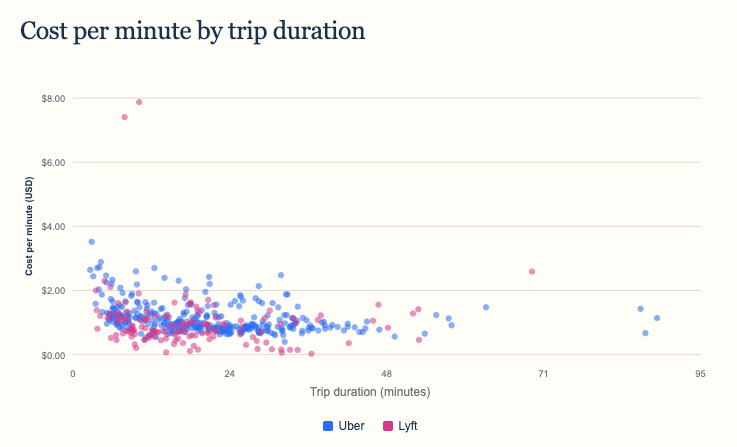
    Scatter plot showing cost per minute for individual Uber and Lyft rides by trip duration

    As with distance, the scatter plot makes the variation visible. Most rides follow a broad downward trend, but there are outliers in both services. Checking both apps before booking still matters more than the historical average.

    Location changes the picture

    Most rides in the dataset came from Orlando, Charlotte, and Atlanta, so I separated those markets and combined the rest. Lyft was cheaper per mile in Orlando and Charlotte, as well as across the combined “other regions.” Atlanta was the exception: Uber averaged $2.75 per mile compared with Lyft at $2.86.
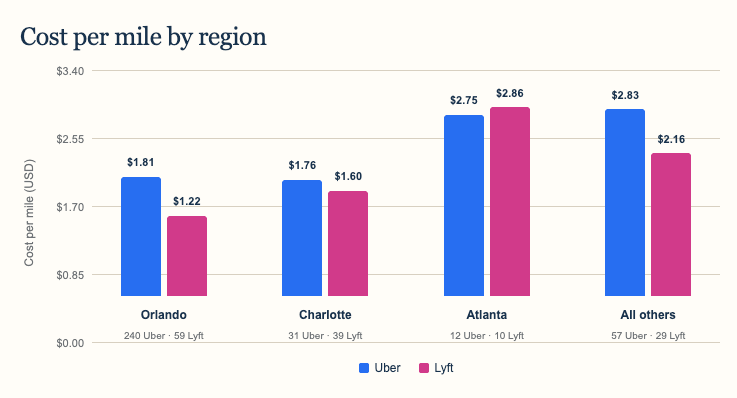
    Bar chart comparing Uber and Lyft cost per mile in Orlando, Charlotte, Atlanta, and other regions

    On a per-minute basis, Lyft was cheaper in all four regional groups. The difference was largest in Orlando, where Uber averaged $0.96 per minute and Lyft averaged $0.75. The two services were much closer in Atlanta and in the combined group of other regions.
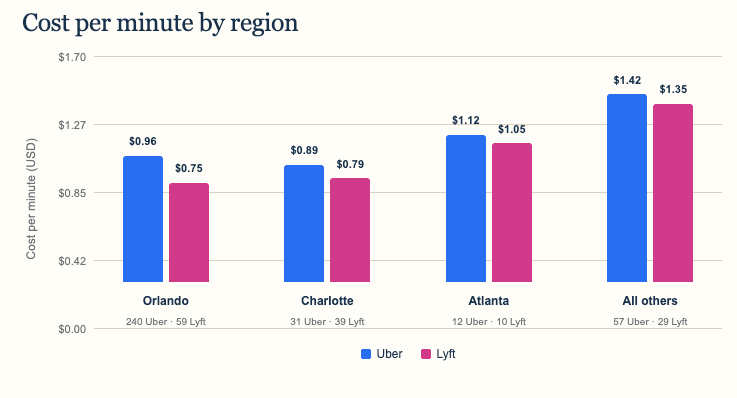
    So, which one is cheaper?

    For my ride history, Lyft wins the overall comparison. It was cheaper per mile, cheaper per minute, and cheaper across every distance band. Uber still performed better in a few slices of the data, most notably rides over 40 minutes and cost per mile in Atlanta, but those groups were relatively small.

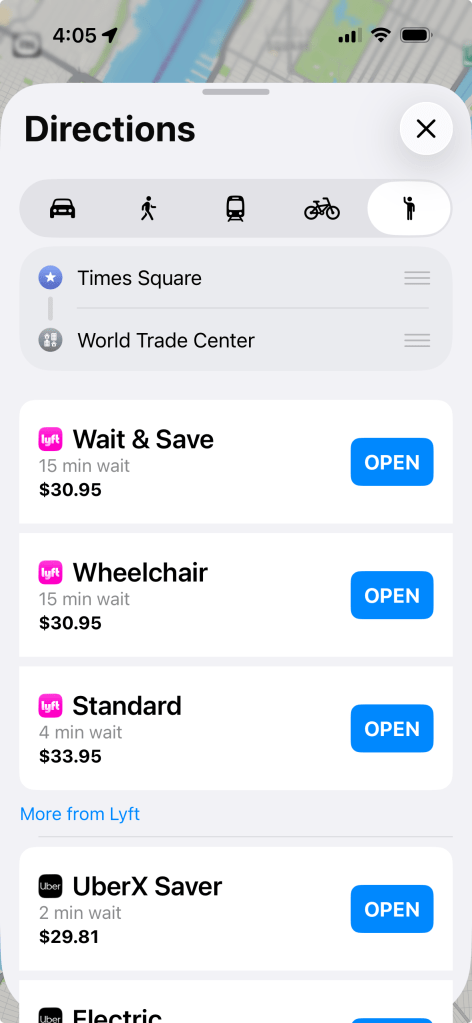
    That said, when it comes time to book a ride I always check both services to see which one offers the cheapest fare for where I’m going. If you have an iPhone this can be done relatively easily using the Apple Maps app. For example, in the below screenshot it is actually Uber that is cheaper this time around.
  • Taxis still fall short

    I was recently in Miami, and like most trips I take in the U.S., my default plan for getting around was Uber or Lyft. I almost never take taxis anymore. It’s been many years since I last relied on one.

    But this time, I made an exception.

    I had just gotten off a cruise ship at the Miami cruise terminal. There was a clearly marked taxi stand right outside, with a line of cabs waiting. Our destination was a coffee shop in downtown Miami on 4th Street, no more than a five-minute drive. I could have called an Uber, but the taxis were already there, luggage in hand, no waiting. It seemed more convenient.

    I also had a bit of optimism going in. I’ve heard people say taxis have gotten better over the years. Some folks who strongly dislike Uber and Lyft will tell you taxis are fairer to drivers, better regulated, and generally less sketchy than they used to be 10 or 15 years ago. So I figured, fine, let’s give taxis another shot.

    That optimism didn’t last long.

    We got into the first cab in line, loaded our luggage, and told the driver where we were going. The moment he realized it was only a five-minute trip, his mood visibly shifted. He was clearly annoyed, borderline angry, that we weren’t going somewhere farther, like the airport.

    I get it. Longer trips pay more. But at the end of the day, taking fares is the job, and giving passengers attitude because the ride is short is just unprofessional.

    We got in the back seat and started driving. About halfway there, we stopped at a traffic light next to another taxi. Our driver rolled down his window. The other cab rolled down theirs. Then, right in front of us, our driver started complaining about us to the other driver, about how short the trip was and how ridiculous it was.

    We’re sitting right there in the back, listening to him complain about us like we weren’t even there. It was surreal.

    Then things got worse.

    As we approached 4th Street, our actual destination, the driver blew right past it. No turn. We kept going. 3rd Street. 2nd Street. 1st Street.

    Only then does he say, “Oh, you were going to 4th Street, weren’t you? Guess we’ll have to go around the block.”

    We looped all the way around, taking the long way back.

    I don’t believe for a second that he missed the turn by accident. I’m confident he did it intentionally to run up the meter. This is exactly the kind of behavior taxis have been infamous for forever, taking the long way, especially when you know the passengers are tourists.

    Eventually, we arrived.

    I asked how much it was.

    “Eighteen dollars.”

    For a five-minute drive. An Uber for the same trip would have been around $8.

    I asked if he took credit cards.

    “No. Credit card machine is broken.”

    At that point, I had basically hit every taxi cliché in one ride:

    • Driver gives attitude over a short trip
    • Complains about passengers while they’re in the car
    • Takes the long way to inflate the fare
    • Credit card machine “broken”

    We gave him a $20 bill, told him to keep the change, and left. The rest of the day was fine, but the experience stuck with me.

    What really struck me is how little taxis seem to have learned, even after more than a decade of competition from Uber and Lyft. This ride could have happened in 2006 and it would have felt exactly the same.

    The system feels fundamentally broken. Drivers are incentivized to behave badly, take longer routes, avoid short trips, and squeeze tourists for a few extra dollars. Because there’s no real accountability, the same behavior persists year after year.

    For all their faults, Uber and Lyft got one thing very right: incentives.

    Drivers aren’t paid more for taking longer routes, so there’s no reason to intentionally miss turns. If this had been an Uber, I’m confident the driver would have taken the most direct path, because dragging it out wouldn’t benefit them at all.

    So when people tell me, “Taxis are better now,” or “They’ve adapted,” I can only speak from experience. As of 2026, in Miami, they haven’t. They’re still just as scummy and unreliable as they’ve always been.

    Maybe in another 10 years they’ll finally figure it out.

    Or be replaced by Waymo.