Have you ever noticed how, as you grow older, the years seem to pass by more quickly? Many people share this experience, and it’s not just your imagination. This phenomenon can be explained by several psychological and neurological factors, with one particularly interesting explanation known as the Proportional Theory.
Understanding the Proportional Theory
The Proportional Theory suggests that as we age, each year represents a smaller proportion of our total life, making time feel like it’s accelerating. When you are young, a year is a significant part of your life. For instance, to a 10-year-old, a year is 10% of their life. However, to a 50-year-old, a year only accounts for 2% of their life. This shift in proportion is a key reason why time seems to speed up as we age.
A Formula for Perceived Life
To quantify this feeling, we can use a formula based on the harmonic series. This approach involves calculating the perceived percentage of your life that has been completed at any given age. Let’s break it down:
- Proportional Contribution: Each year y represents 1 / y of your life at age y. The sum of these fractions up to your current age gives a measure of your perceived life.
- Harmonic Series: The harmonic series is the sum of the reciprocals of the first n natural numbers. For our purpose, we sum the reciprocals of each year up to your current age.
- Normalization: To get a meaningful percentage, we normalize this sum against the harmonic series sum up to an estimated lifespan, such as 80 years.
The Perceived Life Formula
Here’s how you can calculate the percentage of your perceived life completed at any age:
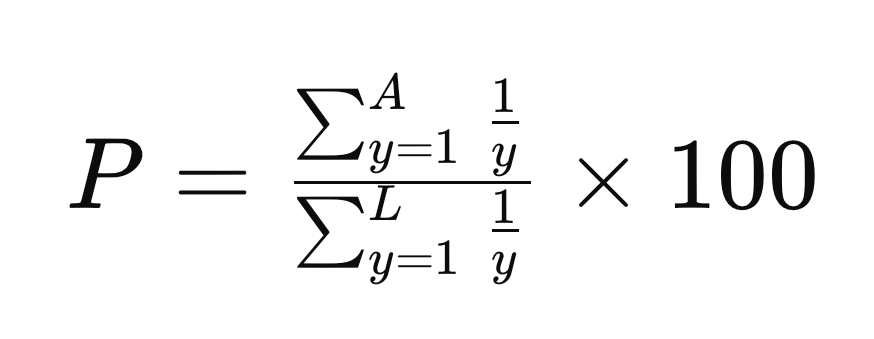
Where:
- A is your current age.
- L is the estimated lifespan (e.g., 80 years).
Let’s Do the Math
Let’s consider an example with a 24-year-old person, assuming an estimated lifespan of 80 years. The steps are as follows:
- Calculate the harmonic sum up to age 24.
- Calculate the harmonic sum up to the estimated lifespan of 80 years.
- Normalize the harmonic sum of age 24 against the sum up to 80 years.
Running this formula gives us a perceived life percentage of approximately 76.04% for a 24-year-old. This means that, based on the Proportional Theory and our harmonic series approach, a 24-year-old feels as though they’ve experienced around three-quarters of their life’s perceived time.
Below is a table with the same calculation done for other ages.
| Age | Life Expectancy | Perceived Life Percentage Completed |
|---|---|---|
| 1 | 80 | 20.14% |
| 10 | 80 | 58.99% |
| 20 | 80 | 72.46% |
| 30 | 80 | 80.46% |
| 40 | 80 | 86.17% |
| 50 | 80 | 90.61% |
| 60 | 85 | 93.12% |
| 70 | 90 | 95.09% |
| 80 | 95 | 96.67% |
| 90 | 100 | 97.98% |
| 100 | 105 | 99.07% |
Why This Matters
Understanding why time seems to fly by as we get older can have profound implications for how we choose to live our lives. Recognizing that our perception of time accelerates with age can encourage us to seek out new experiences, break out of routines, and make the most of each year, regardless of how quickly it seems to pass.
Final Thoughts
The Proportional Theory provides a fascinating lens through which to view our perception of time. By quantifying this perception, we gain insight into why our childhood summers seemed endless, while our adult years feel like they pass in the blink of an eye. Embracing this understanding can help us live more fulfilling lives, cherishing each moment as it comes.
 Kyle Piira