I use ride-hailing apps fairly often, so I was curious whether Uber or Lyft is cheaper on average. To find out, I downloaded my complete ride history from both companies and compared what I paid across 477 trips.
The short answer is that Lyft was cheaper most of the time. Across 340 Uber rides and 137 Lyft rides, Lyft had a lower aggregate cost per mile and per minute, and it was cheaper across every distance band.
This is not a comparison of simultaneous quotes for identical trips. The rides took place at different times and in different locations, so the results describe my own experience rather than guarantee which app will be cheaper for any particular trip.
The overall comparison
To compare rides of very different lengths, I divided total spending by total miles and total travel minutes for each service. On that basis, Uber averaged $1.98 per mile and $1.03 per minute, while Lyft averaged $1.61 per mile and $0.93 per minute. That made Lyft about 19% cheaper per mile and 10% cheaper per minute.
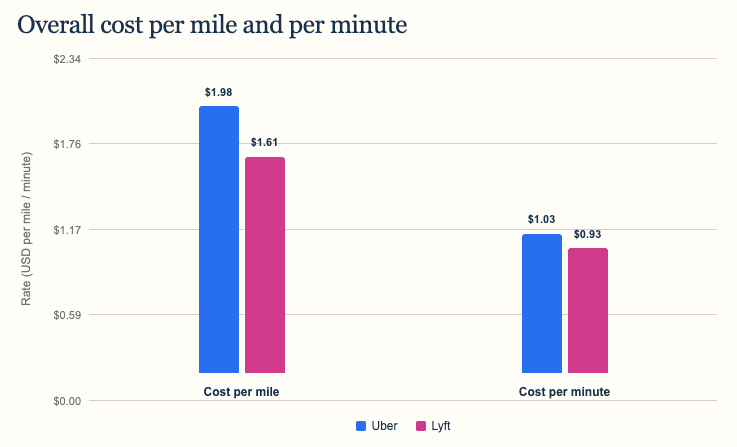
Aggregate rates are calculated as total cost divided by total miles or minutes, so each mile or minute carries equal weight.
Short rides are expensive per mile
Rides under five miles cost roughly $4.20 per mile on Uber and $3.87 on Lyft. Once trips reached 20 miles, those figures fell to about $1.58 and $1.35, respectively. Base fares and fixed fees get spread across more miles on longer trips.
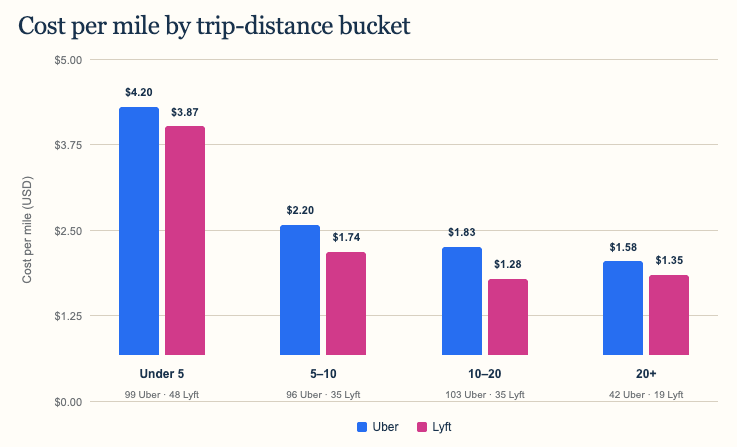
Lyft was cheaper per mile in all four distance groups. Its advantage was modest for rides under five miles and for rides over 20 miles, but wider in the middle: Lyft cost about 21% less per mile for five-to-ten-mile trips and about 30% less for ten-to-twenty-mile trips.
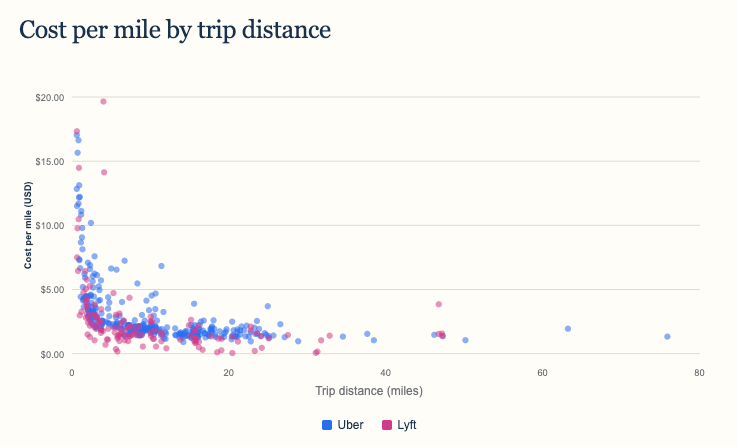
The individual rides show why an average only tells part of the story. Prices vary widely on short trips, while longer rides cluster into a narrower cost-per-mile range. Surge pricing, fees, location, and ride type can easily overwhelm the average on any single booking.
The comparison by trip duration
Cost per minute also generally declined as rides got longer. Lyft was cheaper in the first three duration groups: under 10 minutes, 10–20 minutes, and 20–40 minutes. The largest gap appeared in the 20–40 minute group, where Uber averaged $0.99 per minute versus $0.72 for Lyft.
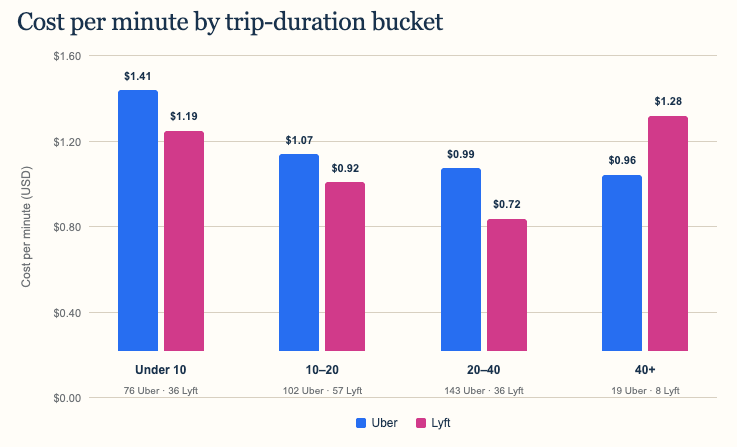
Uber reversed the result for rides lasting 40 minutes or more, at $0.96 per minute compared with $1.28 for Lyft. That result needs extra caution, however: the group contains only 19 Uber rides and eight Lyft rides, so a handful of unusual fares can move the average substantially.
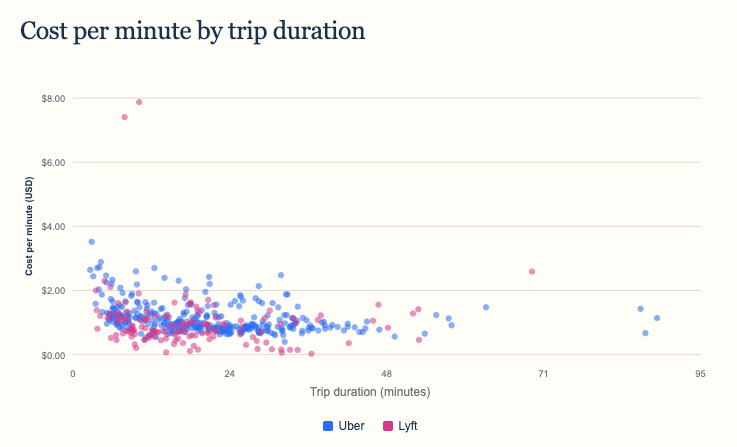
As with distance, the scatter plot makes the variation visible. Most rides follow a broad downward trend, but there are outliers in both services. Checking both apps before booking still matters more than the historical average.
Location changes the picture
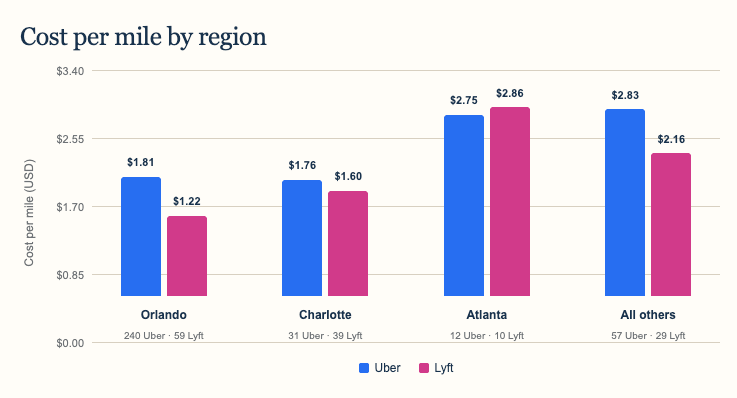
Most rides in the dataset came from Orlando, Charlotte, and Atlanta, so I separated those markets and combined the rest. Lyft was cheaper per mile in Orlando and Charlotte, as well as across the combined “other regions.” Atlanta was the exception: Uber averaged $2.75 per mile compared with Lyft at $2.86.
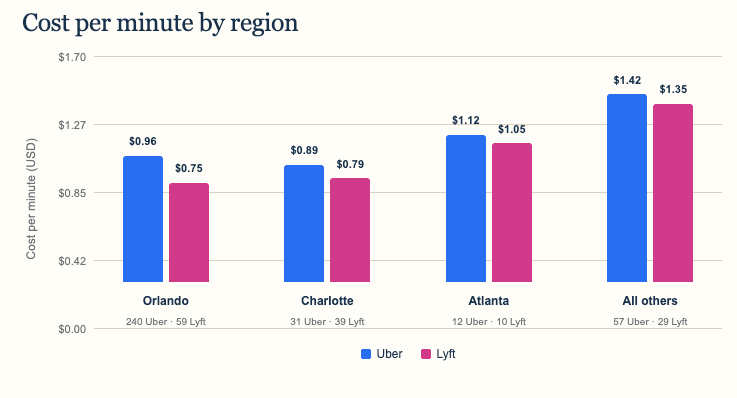
On a per-minute basis, Lyft was cheaper in all four regional groups. The difference was largest in Orlando, where Uber averaged $0.96 per minute and Lyft averaged $0.75. The two services were much closer in Atlanta and in the combined group of other regions.
So, which one is cheaper?
For my ride history, Lyft wins the overall comparison. It was cheaper per mile, cheaper per minute, and cheaper across every distance band. Uber still performed better in a few slices of the data, most notably rides over 40 minutes and cost per mile in Atlanta, but those groups were relatively small.
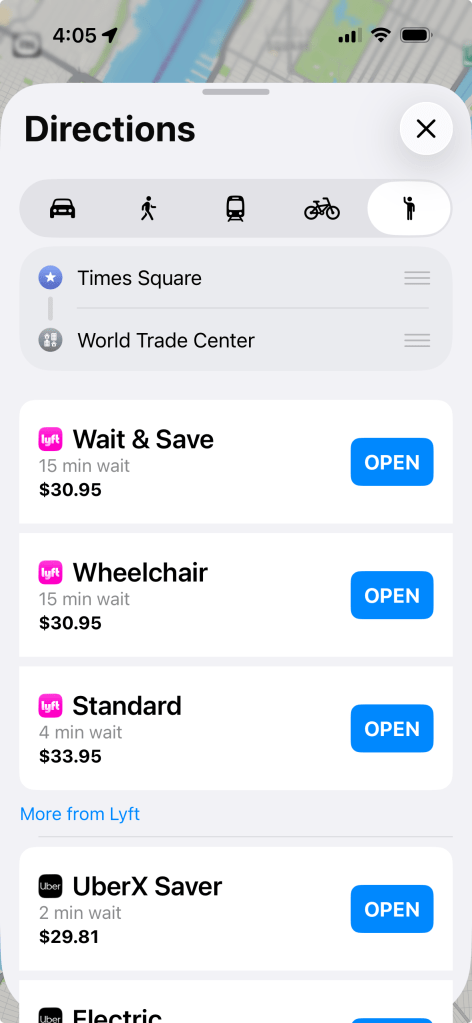
That said, when it comes time to book a ride I always check both services to see which one offers the cheapest fare for where I’m going. If you have an iPhone this can be done relatively easily using the Apple Maps app. For example, in the below screenshot it is actually Uber that is cheaper this time around.