I recently came across an intercity bus service starting up in Europe that I haven’t been able to stop thinking about. It’s an overnight bus, but not in the usual sense. Instead of upright seats and cramped legroom, the buses are built around fully lie-flat seats, similar to what you’d find in first class on a long-haul flight.
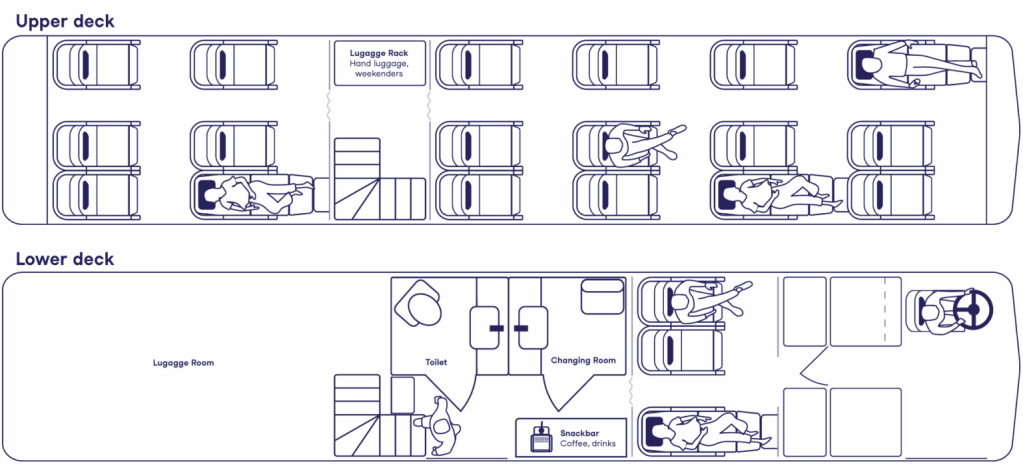
The idea is almost obvious once you hear it. Airlines already know how to make seats people can actually sleep in for eight or ten hours. So what happens if you take that same idea and put it on a bus, where the trip is slower but much cheaper to operate? At that point the comparison is no longer bus versus plane, but time versus comfort.
If the entire trip happens while you’re asleep, the extra travel time matters a lot less. You board at night, go to sleep, and wake up somewhere else. There’s no early alarm, no airport security, and no sitting upright trying to doze for ninety uncomfortable minutes. In the best case, it barely feels like travel at all.
Where this really starts to make sense is for trips that are just a bit too long to drive comfortably in one day. I live in Charlotte, North Carolina, and some of my family lives in Orlando. That drive is about eight hours on a good day. It’s long enough that you lose a full day to it, but short enough that flying can feel like overkill once you factor in the airport time.
An overnight bus fits almost perfectly there. You leave Charlotte around 10 p.m., sleep through the night, and arrive in Orlando early the next morning. You didn’t spend the day driving, and you didn’t spend the night in a hotel. You just… arrived.
That said, there’s one part of the European implementation that I think really works against the whole idea. Many of these routes include multiple intermediate stops. A single bus might start in one city, stop in several others along the way, and keep going past your destination.
That sounds efficient on paper, but it creates a real problem for passengers. If you’re getting off at one of those intermediate cities, you may be forced to wake up at two or three in the morning. At that point the magic is gone. You’re tired, it’s dark, and there’s nowhere to go. Now you need a hotel anyway, which defeats one of the biggest advantages of the service.
I think these routes should be strictly point to point. One bus per corridor. Charlotte to Orlando. Charlotte to Tampa. Charlotte to Miami. Airlines fill planes on these routes every single day. There’s no reason a well-designed overnight bus couldn’t fill up too.
Going point to point also opens up something I think is crucial: treating the bus more like a hotel than a vehicle. Imagine arriving at your destination at 6 a.m. but not being forced off the bus immediately. Instead, your ticket includes a checkout time, maybe 9 or 10 a.m. If you want to get up and leave right away, you can. If you want to keep sleeping, you can do that too.
That small change makes a huge difference. It turns the experience into transportation plus lodging, rather than just a long ride.
Once you think about it that way, other details fall into place. Clean bathrooms are non-negotiable. Food should be available, even if it’s simple. A small breakfast option at the arrival depot would make mornings feel less rushed. Luggage handling could work the same way hotels do, with a claim system so people can leave when they’re ready instead of all at once.
In theory, you could even plan trips where you string together several of these overnight routes and barely use hotels at all.
This kind of service feels especially relevant in the United States. We used to have a far more extensive passenger rail network, but much of it is gone now, and recreating it at a national scale would take decades. What we do have is a massive interstate highway network that already connects most major cities.
Intercity buses can take advantage of that immediately. The infrastructure is already there, and it’s effectively subsidized. For trips in the seven-to-ten-hour range, a comfortable overnight bus could easily compete with flying for a lot of people.
Looking further ahead, this gets even more interesting when you consider autonomous driving. Long highway stretches are exactly where autonomy performs best. If the bus doesn’t need a human driver, that role could shift toward an onboard attendant instead. Someone whose job is to help passengers, keep things running smoothly, and generally make the experience better.
That kind of staffing change could actually improve the service rather than cheapen it.
This isn’t going to replace planes, and it’s not meant to. Nobody is taking an overnight bus from the East Coast to the West Coast. But for the many city pairs that sit in that awkward middle distance, this feels like a genuinely underexplored option.
I would be surprised if something like this doesn’t eventually appear in the U.S. Once someone gets the execution right, it’s the kind of idea that feels obvious in hindsight.
 Kyle Piira