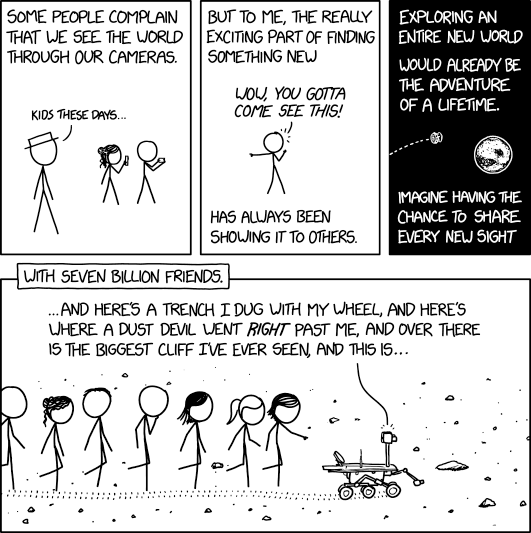
Goodbye to the Opportunity Rover. May you rest in peace.

I think a big difficulty in building peer-to-peer search engines like YaCy is the lack of fraud resistant link graph to rank webpages. There is no way to know whether one page really links to another without crawling and parsing it yourself, and that’s too slow for real time applications.
Technologically you could store the graph in a distributed hash table but that doesn’t really solve the fraud problem since anyone could modify the data.
Just found out about Zotero, which is a FOSS tool for organizing bookmarks to articles and papers. It also has a browser extension to save articles and integrates with LibreOffice for bibliographies.
AdNauseam is a browser extension that both hides and clicks on all ads for you. I think it’s mainly designed to confuse advertising systems. Unfortunately, it appears to have been banned from the Chrome Web Store.
Just spend 3 hours trying to figure out why systemd was killing my screen/tmux processes on logout. For anyone with the same issue:
Was what fixed it for me in KDE Neon (Ubuntu 18.04).
I think the reason that Chromium has really taken over is that they provided a super modular system using a popular programming language (C++) that allowed smaller companies to innovate on browser UI/UX without having to spend millions reinventing the rendering engine.
Meanwhile, Firefox uses a more obscure language (Rust) making it less attractive for startups to build on top of.
There is no word in the English language that will cause me to lose interest in a project faster than “blockchain”.
Sounds like MongoDB‘s Server Side Public License has been a complete failure. Both Redhat and Debian have removed them for their repos. AWS and Azure both built their own MongoDB API compatible databases and have started migrating customers over.
Messaging is in a poor state these days.